

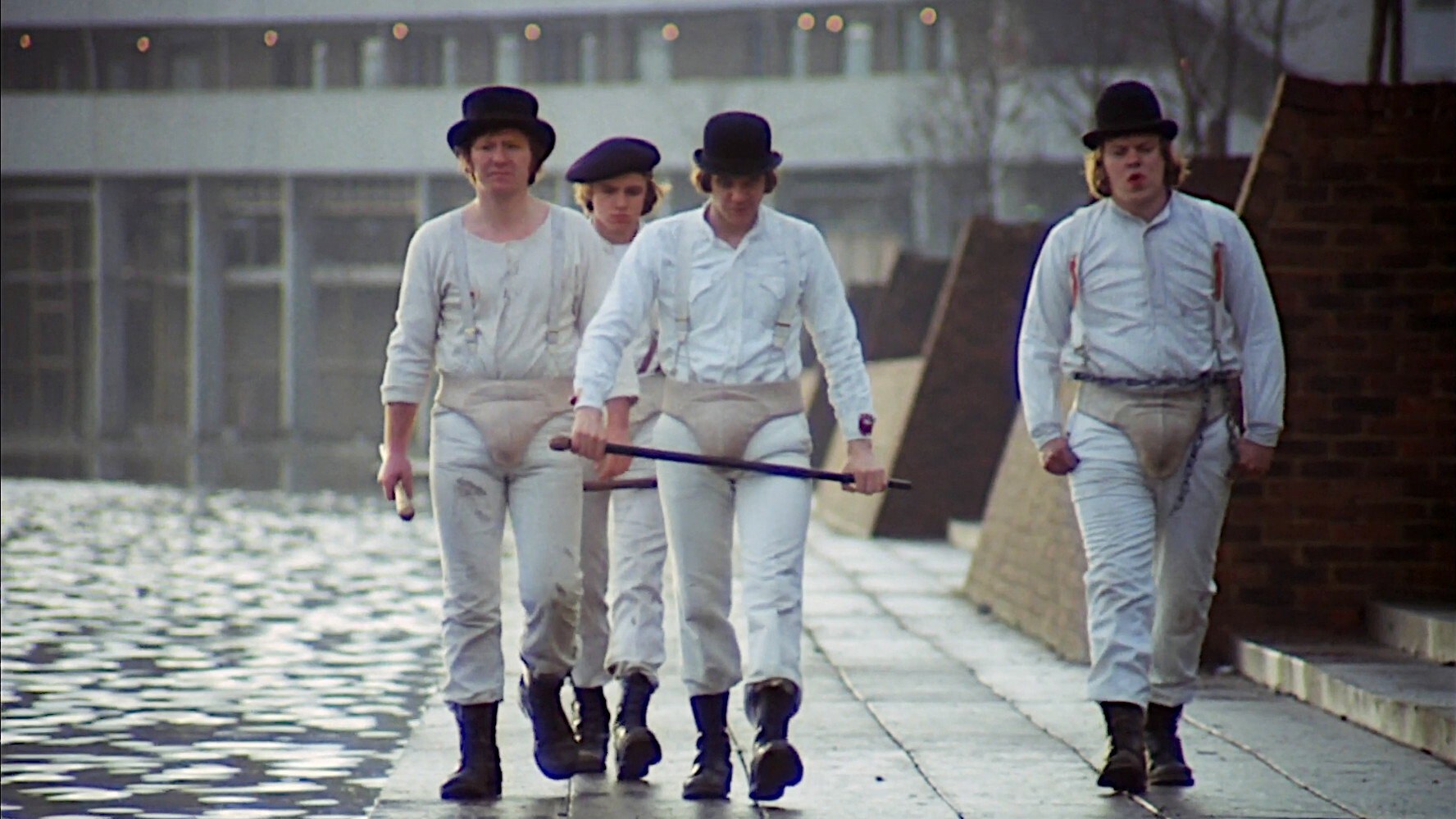
Les Droogs
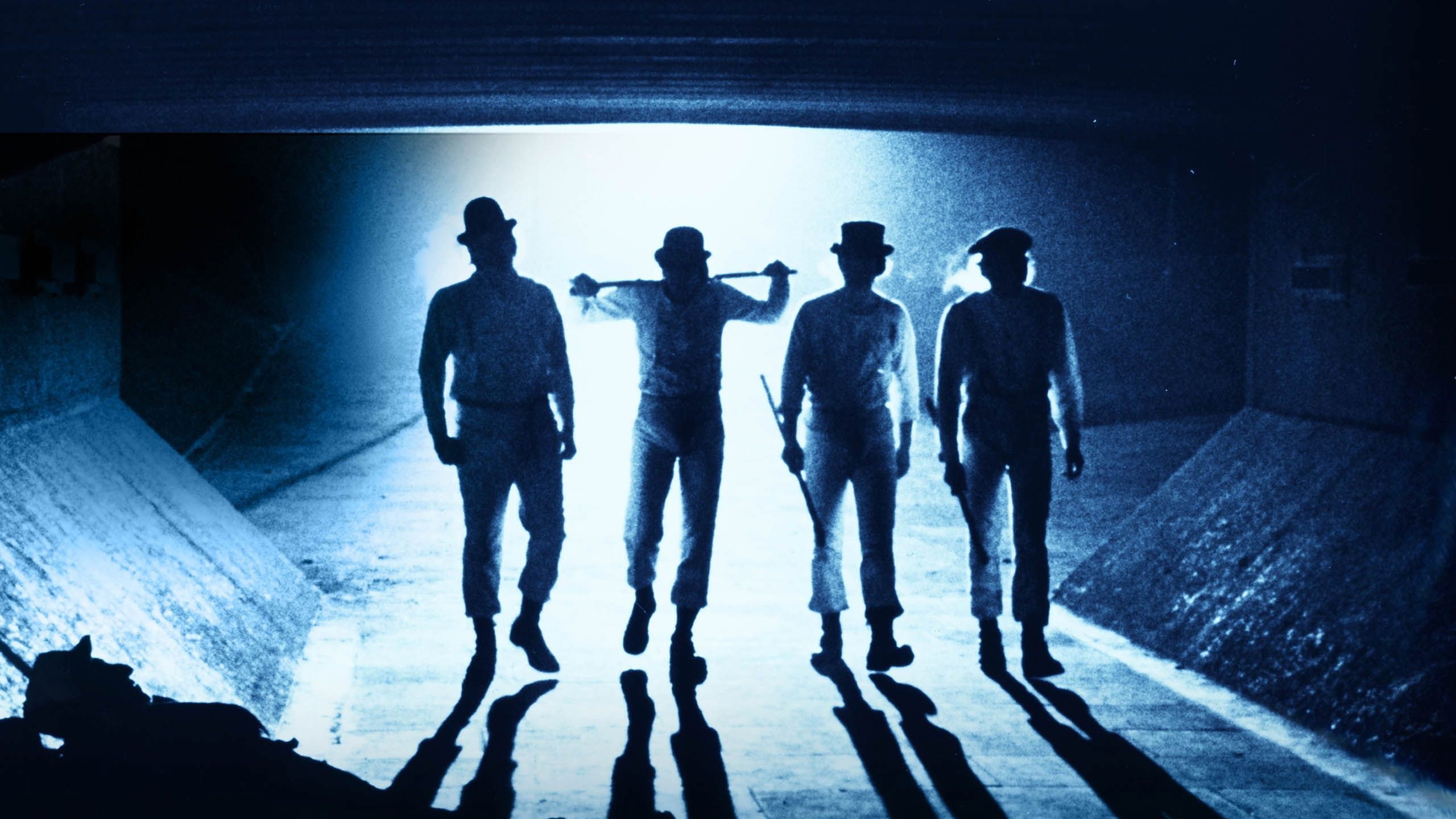
Alex parle un argot dont on apprend peu à peu les mots. L’uniforme produit le même effet. On finit par reconnaître chacun à son chapeau ou à sa façon de porter ses vêtements.
Idée de costume. Jouez sur les différences dans une tenue commune. Chemise et pantalon blancs, bretelles et bottes noires. Pour Alex, un faux cil distinctif à droite et un chapeau melon.
L’essai intégral et le guide détaillé sont en anglais. Lire l’essai · Voir les références visuelles

The Reel Peoples · No. 11 of 16
The Droogs
Notes on a Gang That Made a Language Its Own
Perpétue Kettlewell, written at the fires, 2285
Every people in this series has a dress. Very few have a dialect. The droogs have both, and they invented both themselves, between the ages of fifteen and nineteen, in a city that had given them nothing else to do.
We know them from A Clockwork Orange (1971), the reel Stanley Kubrick made from Anthony Burgess’s novel of 1962. Their leader is Alex. His droogs, which is to say his friends, are Georgie, Dim, and Pete. They live in a near-future Britain of concrete housing estates, broken lifts, and indifferent parents, and they spend their nights in a milk bar called the Korova, drinking milk laced with drugs, before going out to do what they call ultraviolence.
I want to be plain about that last word before I go on, because cruelty is part of how Alex keeps this gang together. The droogs beat strangers, rob them, break into their houses, and worse. The reel shows it, and the novel shows more. I’m not going to linger there. My interest is in something the old world found harder to look at: the droogs were also the most fashionable people of their age, and the old world’s young copied them.

The tongue
Listen to Alex speak and you’ll understand half of it, if you’re lucky. His friends are his droogs. A girl is a devotchka, a boy is a malchick, and people in general are lewdies. Eyes are glazzies, the head is the gulliver, the mind is the rassoodock, blood is krovvy, and to hit someone is to tolchock them. Anything good is horrorshow. Milk is moloko. And an apology, in Alex’s mouth, becomes an appy polly loggy, which tells you exactly how sincerely he means it.
The tongue is called Nadsat, and Burgess built it himself, mostly out of Russian, with some Cockney rhyming slang, some schoolboy babble, and some deliberately antique English. Nadsat is the Russian ending for the teen numbers; the word means, more or less, teen. Burgess said he invented it so that the novel wouldn’t date the way real slang does, and he was right: it sounds as strange now, in 2285, as it did when it was written.
M. A. K. Halliday, the old world’s great theorist of language and society, published an essay in 1976 called “Anti-Languages,” about the secret tongues of thieves, prisoners, and outcasts. An anti-language, he argued, is the language of an anti-society: a group that sets itself up inside a larger society as a conscious alternative to it. Anti-languages replace the ordinary words for the things that matter most to the group with new ones, and invent dozens of words for those things. Nadsat fits his description precisely. Its densest vocabulary is for bodies, violence, clothes, and drugs, because those are the things the droogs care about. Every word they speak tells the old world it isn’t invited.
A reader meets Nadsat on the page and has to work it out alone. Israel Noletto and Margareth Torres de Alencar Costa, writing in Ilha do Desterro (2017), point out that the reel gives the tongue a voice instead: Kubrick makes it a spoken language, and the viewer learns it from Alex’s mouth, with the pictures to help. The first minutes are the test. As the camera draws back from Alex’s eyes, his voice introduces his three droogs, and I can count them beside him. I can see the moloko, too. The names of what goes into it I keep hearing and keep failing to learn. That’s where I began to notice how much I was taking on his word.


The uniform
And look at what they wear. The droogs dress alike, in white: white shirts, white trousers, braces, heavy black boots, and on top of it all, worn outside the trousers, a hard groin protector of the kind the old world’s cricketers wore underneath. They carry canes. They wear hats, Alex a black bowler. And on Alex’s right eye, and only his right eye, there’s a set of false eyelashes, top and bottom.
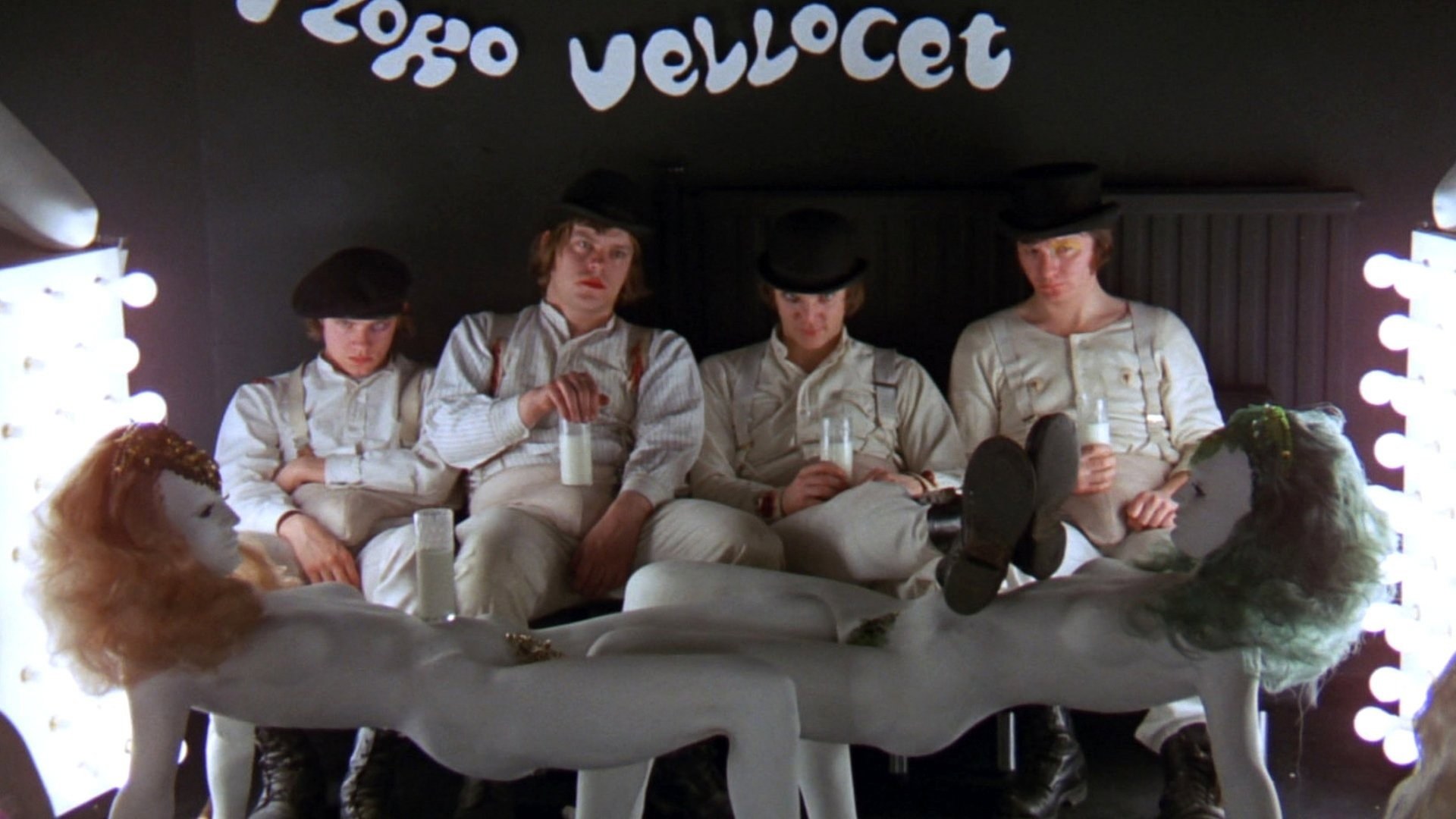
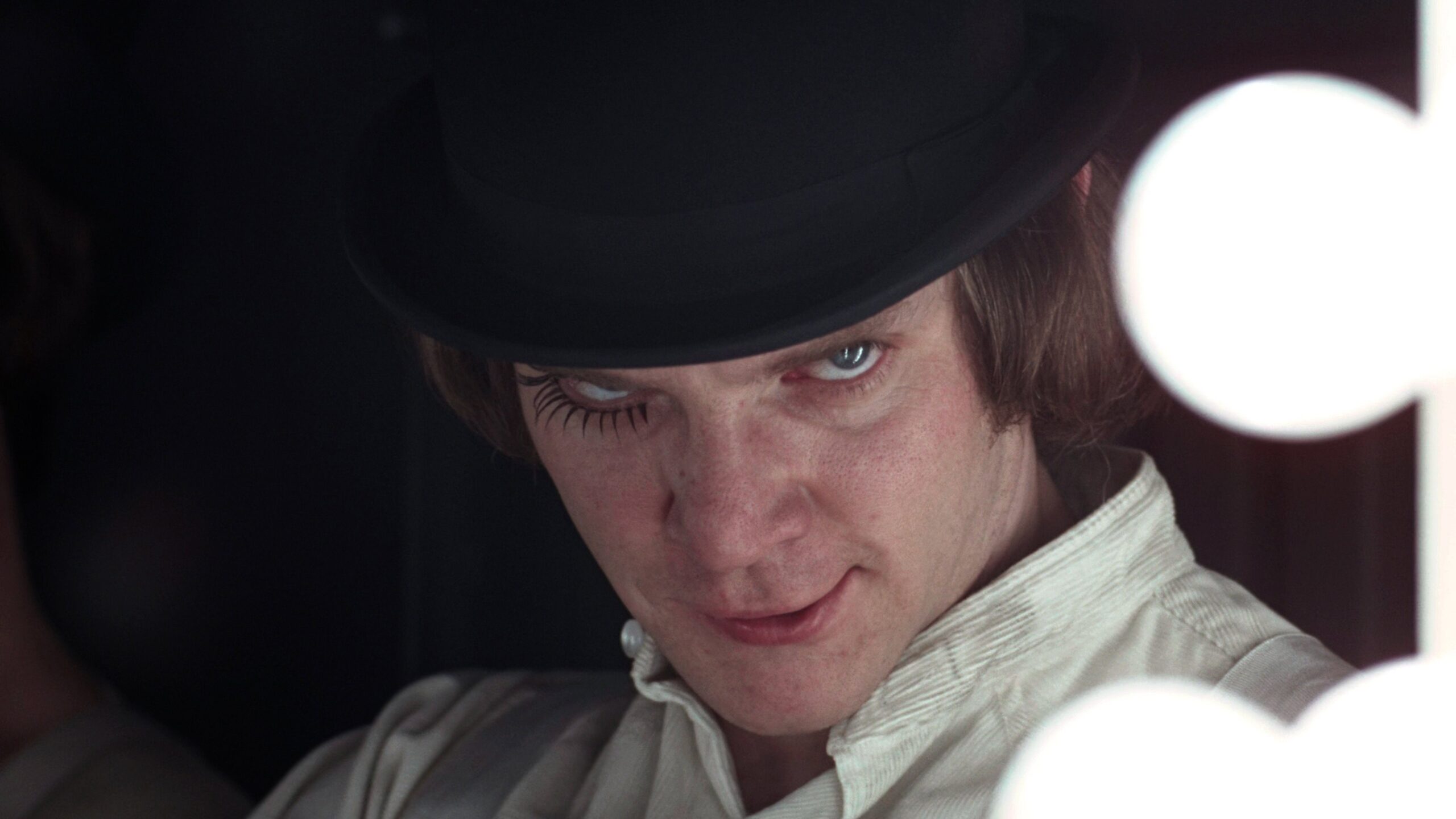
The reel’s costume designer, Milena Canonero, was working on her first film. She took her inspiration, she said later, from the youth cultures she saw on the streets of London, and the result was a uniform made of class symbols scrambled out of order: the worker’s boots and braces, the gentleman’s bowler and cane, the sportsman’s cricket whites, and the dandy’s eyelash. The story goes that the codpiece happened by accident, when Malcolm McDowell, who played Alex, arrived at a fitting in his own cricket gear and Kubrick told him to put the protector on the outside. The hats took longer. Photographs in Kubrick’s archive show the team trying cowboy hats, peasant hats, and military caps; the droogs didn’t work, the British Film Institute’s archivists report, until somebody tried bowlers.
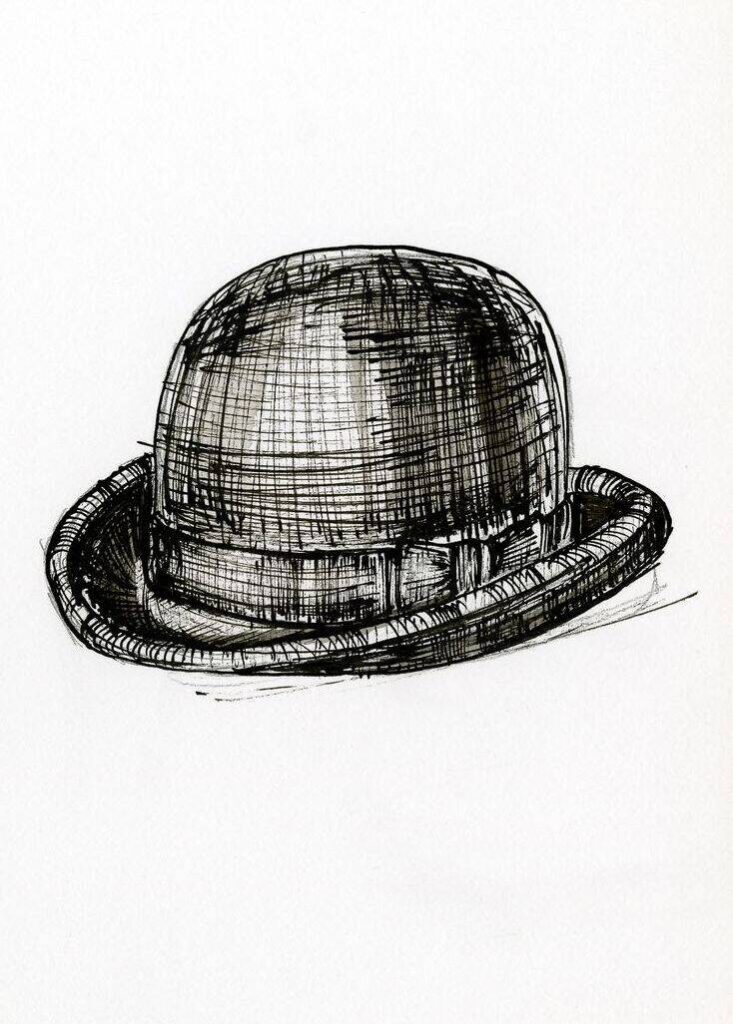

Dick Hebdige, in Subculture: The Meaning of Style (1979), argued that the old world’s youth subcultures spoke through what they wore, by bricolage: taking ordinary objects out of their places and putting them together in ways that made them mean something new and, usually, something rude. His examples were the mods, the skinheads, and the punks. The droogs are a subculture built on exactly that principle, and the old world’s critics noticed that the punks who appeared a few years after the reel looked remarkably like its heirs.
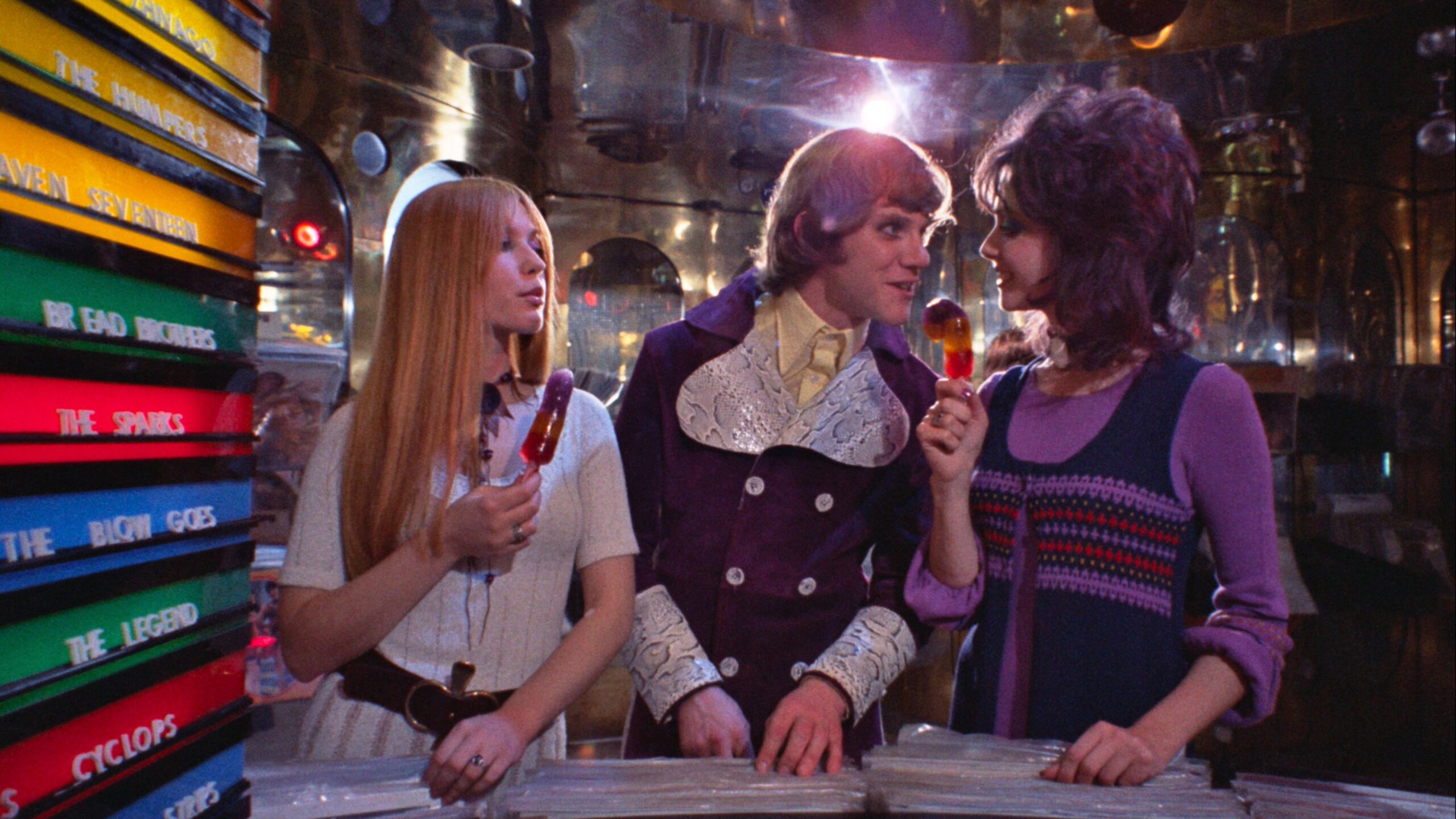
Off duty, Alex changes register. In the record shop he wears a long, high-collared coat of Edwardian cut, and the shop’s two girls dress in the bright synthetic colours of the reel’s near future. The whites are a uniform. The coat is a self.
Ludwig van
There’s one more thing Alex loves, and it’s the strangest. He loves the music of Beethoven, whom he calls Ludwig van, above all the Ninth Symphony, and he listens to it in his bedroom with a devotion the reel presents as almost religious. It’s the one thing about him the old world could have approved of. The reel makes it the instrument of his punishment.

When Alex is finally caught and imprisoned, he volunteers for an experimental treatment called the Ludovico technique, which promises to cure him of violence by conditioning him to feel sick whenever he thinks of it. They strap him into a chair, clamp his eyes open, and make him watch films of violence while a drug makes him ill. The Ninth plays on the soundtrack of one of them. When he comes out, he can’t defend himself, and he can’t bear the music he loved. The state has made him good by making him less than a person, and the reel asks whether that is goodness at all.
At the fires we keep a law: the stranger drinks first. At the Korova Milk Bar, the stranger drinks first too. The moloko is laced.
The copies
Here the reel stops being a story and becomes, for an anthropologist, a piece of evidence. After it opened in Britain, the newspapers began to report crimes committed by young men dressed as droogs, and courts began to hear defendants blame the reel. In 1973, Kubrick asked for the film to be withdrawn from British cinemas, and it stayed withdrawn until after his death.
Stanley Cohen, in Folk Devils and Moral Panics (1972), published the same year the reel reached British screens, described how the old world’s press and courts could turn a few young people in a particular costume into a national menace, and how the menace, once named, began to recruit. I read the record of the copies with his book open beside it. Some young men did dress as droogs and did terrible things. The papers rarely asked how many more were simply blamed for how they looked. A costume can be made to testify to almost anything, and the people who read it are seldom as careful as the people who wear it.
The reel’s most careful scholar, Peter Krämer, in his study A Clockwork Orange (2011), worked from the Kubrick archive and set aside the old question of whether the reel made people violent. He asked instead how the reel took part in that very argument. It’s the right question for a film about a state that remakes a boy by showing him pictures, which was then accused of remaking boys by showing them pictures. A costume is also a picture, and every one of the old world’s copycat droogs had first been an audience.
Krämer has a second piece of evidence, and I trust it more than the newspapers: the letters American cinemagoers wrote to Kubrick soon after the reel opened, which he studied in Participations (2011). The writers brought different expectations, made sense of the reel in different ways, and found their own reasons to enjoy it. A bundle of letters can’t tell me how many young men copied the droogs, or whether the people who wrote were like the people who didn’t. It tells me what the writers said about themselves. That’s already more than the papers asked.
The missing chapter
One last fact, because I think it’s the most important. Burgess’s novel has twenty-one chapters. The edition first published in America had twenty, and the reel was made from that edition. In the missing chapter, Alex, now eighteen, finds himself bored by violence. He meets an old droog who has married, imagines a son of his own, and begins, without anyone’s treatment, to grow up.
Burgess thought that chapter was the point of the book. Kubrick thought it was unconvincing. I’m with Burgess, and I suspect most people who’ve been young are too. The droogs aren’t a people in the way the others in this series are. They’re a phase: a costume, a language, and a set of loyalties that a person wears for a few years and then, if they’re lucky, takes off.
Participant observation
The droogs are the one people in this series that come as a gang or not at all. A lone droog is a man in odd trousers; four are a culture. Come to the October shore as a set: four whites, four pairs of boots, four black hats, and braces over all of it. Give the clothes a family resemblance and let the hats do the introductions.
Learn a dozen words of Nadsat and use them on the friendliest people you meet. Order something from the bar as if it were moloko. And at the end of the night, take the eyelash off. It took Alex a whole missing chapter to learn that, and it’s the difference between wearing a costume and being worn by one.
We’ll keep the kettle on.
The Reel Peoples
Sixteen peoples from the old reels and two from our own shore, written up at the fires by Perpétue Kettlewell, with a costume guide for each.
- No. 1The War Boys of the Citadel
- No. 2The Smokers of the Deez
- No. 3The Citizens of the Capitol
- No. 4The Bartertowners
- No. 5The Vuvalini of Many Mothers
- No. 6The Waiting Ones
- No. 7The Holnists
- No. 8The Londoners of the Traction City
- No. 9The Galadhrim
- No. 10The People of Zion
- No. 11The Droogs
- No. 12The Ape Society
- No. 13The Judges of Mega-City One
- No. 14The Morlocks
- No. 15The Aviators of Airhaven
- No. 16The Tail Section