


Les aviateurs d’Airhaven
Dans Mortal Engines (2018), Airhaven est un port suspendu sous des ballons. Le navire reçoit d’abord un quai; la confiance, elle, se gagne ensuite autour de la table. Les pilotes de la Ligue anti-traction volent pour que d’autres puissent rester sur leurs terres.
Idée de costume. Le long manteau rouge d’Anna Fang, ou du cuir et de la toile prêts pour le vent. Un laissez-passer de quai numéroté complète la tenue.
L’essai intégral et le guide détaillé sont en anglais. Lire l’essai · Voir les références visuelles

The Reel Peoples · No. 15 of 16
The Aviators of Airhaven
Notes on the Anti-Traction League, and a Berth for Strangers
Perpétue Kettlewell, written at the fires, 2285
Photo: AngMoKio, CC BY-SA 3.0

A voice from a town that hangs in the clouds clears a red ship to land at dock seven, and welcomes her by name. I’ve recorded a good many welcomes in these reels. This is the first that comes with a number.
We know them from Mortal Engines (2018), the reel made from Philip Reeve’s novel of 2001, which I’ve already written about from the deck of London. These notes are written from above it. Airhaven is a port slung beneath balloons, a place where pilots, scavengers, and traders of every allegiance come to moor. Among them are the aviators of the Anti-Traction League of Shan Guo, the eastern country of settled cities behind the great Shield Wall. The port belongs to everyone. The League is one of its tenants, and the most interesting.
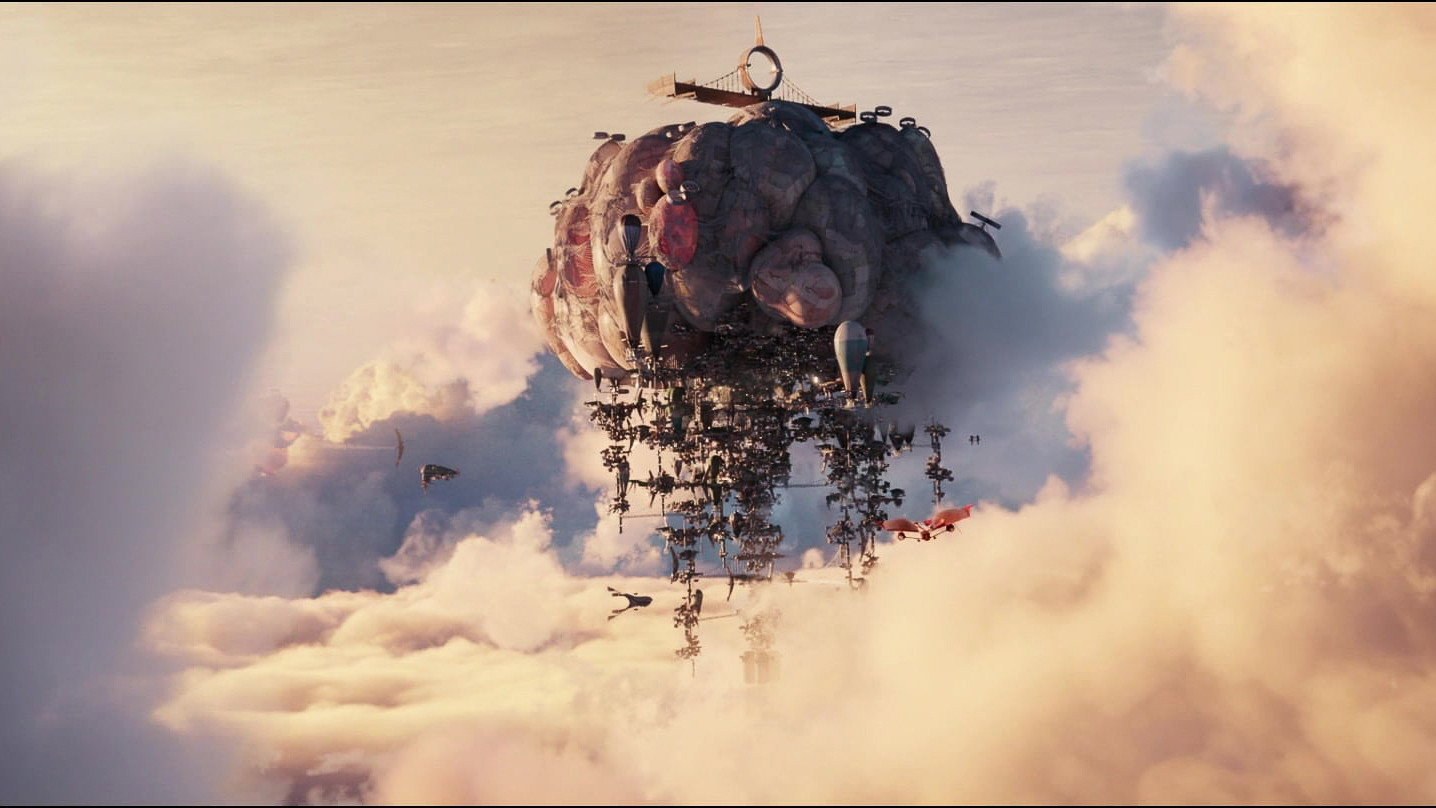
Dock seven
In London, the first voice a newcomer hears belongs to the Gut. A town has just been swallowed, and an announcement tells its people to put their old tech in the bins provided. Airhaven’s voice is different. As Anna Fang brings her ship in, the port clears the Jenny Haniver to land at dock seven and welcomes her by name.
I’d first written that Airhaven names every arrival, as London names none. The reel doesn’t show me that. It shows a named ship with a captain the port already knows, and one landing can’t tell me how a stranger in an unknown craft would be greeted. What it does show me is that the berth comes before anything else.
The reel’s makers imagined Airhaven as neutral ground, a meeting place where guns are banned because a stray shot among the gasbags could bring the whole town down. That’s their account rather than the reel’s, but it fits what I see. Julian Pitt-Rivers, in “The Law of Hospitality” (1977), argued that hospitality turns a dangerous stranger into a guest for a while, on conditions: the host mustn’t insult the guest, and the guest mustn’t behave like the master. Most peoples enforce those conditions with manners. Airhaven’s makers imagined them enforced by the balloons.
The table
A berth isn’t belonging, and the reel shows the difference within the hour. Fang has brought two passengers, Hester Shaw and Tom, a Londoner and an apprentice Historian. When the League’s people sit down with their guests, the questions turn to Tom. What, they want to know, is London building in its cathedral? One of the aviators has no time for the people of the traction cities at all, and dismisses them in a single unkind word.
Then Tom recognises the mark on the device Hester’s mother found, and can say what it belongs to. His Historian’s training is suddenly the most useful thing at the table. What he knows about old things is valuable to the League at precisely the moment when where he learned it counts against him.
I’m glad of that argument. Until the table, the only voices I’d heard on the League were London’s propaganda and Fang’s conviction. The table gives me a third: people inside the League disagreeing about whose lives are worth their trouble.
The loan of the controls
Before any of that, on the way in, Fang does something I didn’t expect. She has Tom hold her controls steady, and asks whether he’s flown before. A bit, he says. She tells him to bring the ship in. Earlier he’d admitted that he once wanted to be an aviator, and that seems to have been enough.
The War Boys taught me what a steering wheel can mean to a people: Nux wouldn’t let another boy so much as hold his. Fang lends hers, and very nearly her life, to a boy from the city that hunts her people. The table will test him later. The controls test him first, and he passes by being useful before anyone has decided what to make of him.
The house that flies
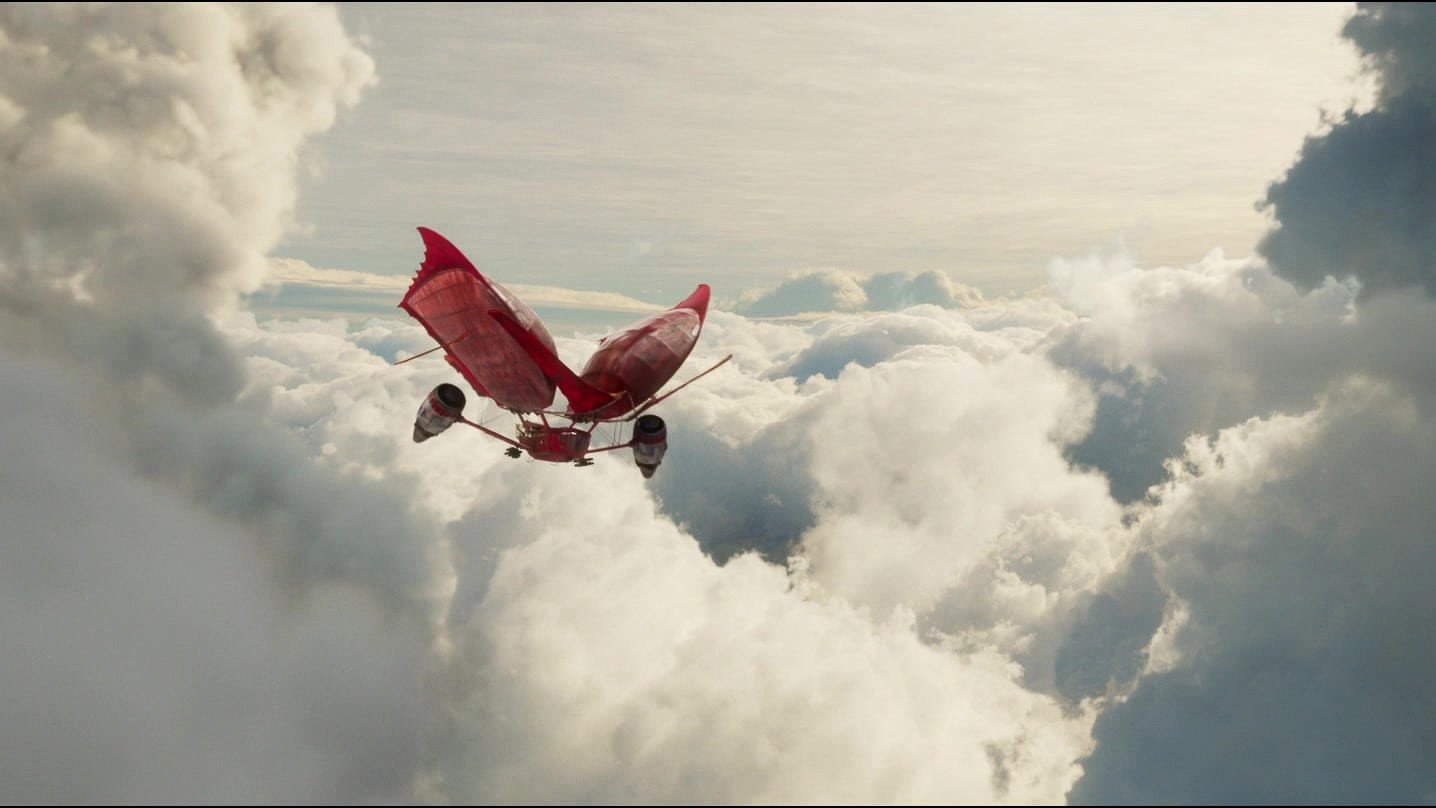
Seen from outside, her ship is a working machine: red wings over a patched, boat-shaped cabin, a craft its designers likened to a giant red moth. Step inside and you’re in somebody’s home. There’s a dashboard of dials and a swivel seat for the pilot, and behind them a little kitchen and a bed, wood panelling, soft furnishings, artwork, and trinkets. Jihae, who plays Fang, put it simply: “It’s her home.”
The production’s account is that Fang built the ship from scrap she stole while she was enslaved, and in the reel she says she was kept as a slave on the ice city of Arkangel and swore never to be owned again. Mary Douglas, in her essay “The Idea of a Home” (1991), argued that a home begins when someone brings a piece of space under control. I’d read that as a sentence about walls until I looked at the cabin. A woman who was once property has built a house nobody can own, because it never stays still long enough to be caught. The kitchen tells me she means to come back to it.
One red coat
Fang wears a long coat of vivid red, the colour of her ship. Monica Alina Toma, writing in Caietele Echinox (2025), reads the coat as part of a heroine’s striking image with a serious commitment to justice underneath, and calls the ship a sanctuary in motion. I went looking among the other aviators for a second coat like it and didn’t find one. The League’s people dress for weather and work, in leathers and layers. The costume department, led by Bob Buck and Kate Hawley, made its own fabrics, then distressed and rubberised them until they looked lived in.
What the pilots share is a sound. The actors who played them built histories for their characters and invented a call-and-response war cry together, and Rege-Jean Page compared chanting it to running with a wolf pack. In the reel, Fang’s crew shout a cry the reel never translates. I’d know these people in the dark before I’d know them by daylight.
Above the wall
London’s officials describe the Anti-Tractionists as people who loathe everything London stands for and hide behind their wall hoarding what they have. Peter Jackson, who co-wrote and produced the reel, turned that around: London’s propaganda calls them terrorists, when what they want is to settle down and farm.
Toma sets the two ways of life side by side. On one side are London’s motion, conquest, and appetite; on the other, the League’s restraint, continuity, and stewardship. Here’s the paradox I can’t get past. The people who stand for staying put are the most mobile people in the reel. They’re hardly ever on the ground, and the country they defend has a wall and a governor. They fly so that the farms behind the wall can stay exactly where they are.

This paragraph gives away a late scene. The port’s protection has its limits. The Stalker who has been hunting Hester, a dead soldier rebuilt as a machine, catches up with her at Airhaven, and the town is destroyed in the fire that follows. Its makers had kept guns out from under the balloons. Nobody had made a rule for a hunter that needs none.
At the fires we keep a law: the stranger drinks first. At Airhaven, the stranger is given a berth first, and the questions wait until he’s sitting down.
Participant observation
Come to the October shore as a flight crew. Fang’s red coat is there for anyone who wants it. The rest of a crew can dress for weather and work, in leather, canvas, and scarves, with things strapped down within reach.
If your crew likes, invent a call-and-response of two lines and use it whenever you find one another again across a field. That’s our idea, not the reel’s, and it’s for willing crew members only.
Better still, come as Airhaven. Make dock passes with numbers on them and hand them to strangers at the fire, with a seat and a welcome. Ask nobody what they’re carrying. That was London’s question.
We’ll keep the kettle on.
The Reel Peoples
Sixteen peoples from the old reels and two from our own shore, written up at the fires by Perpétue Kettlewell, with a costume guide for each.
- No. 1The War Boys of the Citadel
- No. 2The Smokers of the Deez
- No. 3The Citizens of the Capitol
- No. 4The Bartertowners
- No. 5The Vuvalini of Many Mothers
- No. 6The Waiting Ones
- No. 7The Holnists
- No. 8The Londoners of the Traction City
- No. 9The Galadhrim
- No. 10The People of Zion
- No. 11The Droogs
- No. 12The Ape Society
- No. 13The Judges of Mega-City One
- No. 14The Morlocks
- No. 15The Aviators of Airhaven
- No. 16The Tail Section