


Les Smokers du Deez
Le Diacre porte un toast au capitaine de l’Exxon Valdez. Dans les cales, quelqu’un mesure le peu de carburant qu’il reste. Les deux gestes racontent la même dépendance.
Idée de costume. Un long manteau évoque le Diacre. Pour un membre de l’équipage, choisissez des couches plus courtes et un objet qu’on emporterait sur le pont, comme une boîte à rations étiquetée.
L’essai intégral et le guide détaillé sont en anglais. Lire l’essai · Voir les références visuelles

The Reel Peoples · No. 2 of 16
The Smokers of the Deez
Notes on the Church of Eternal Growth
Perpétue Kettlewell, written at the fires, 2285
Photo: Jks93, CC BY-SA 3.0
Most peoples bury their dead in the ground. The Smokers, who have no ground, worship the dead the ground once buried: they pump them up out of the dark and set them on fire. They call it go-juice. I call it the communion of the very long dead, and I’ve stopped expecting the Smokers to find that unsettling.
We know them from one reel, Waterworld (1995), directed by Kevin Reynolds, and from the shrines where the old world re-enacted it for crowds. They live on a sea that has eaten every coast, in a rusting oil tanker they call the Deez, under a priest-king called the Deacon. Their neighbours, the Atollers, hoard soil and water. The Smokers hoard what lay underneath both. They’re named for what comes out of their engines and out of their mouths, and they see no reason to tell the two apart.
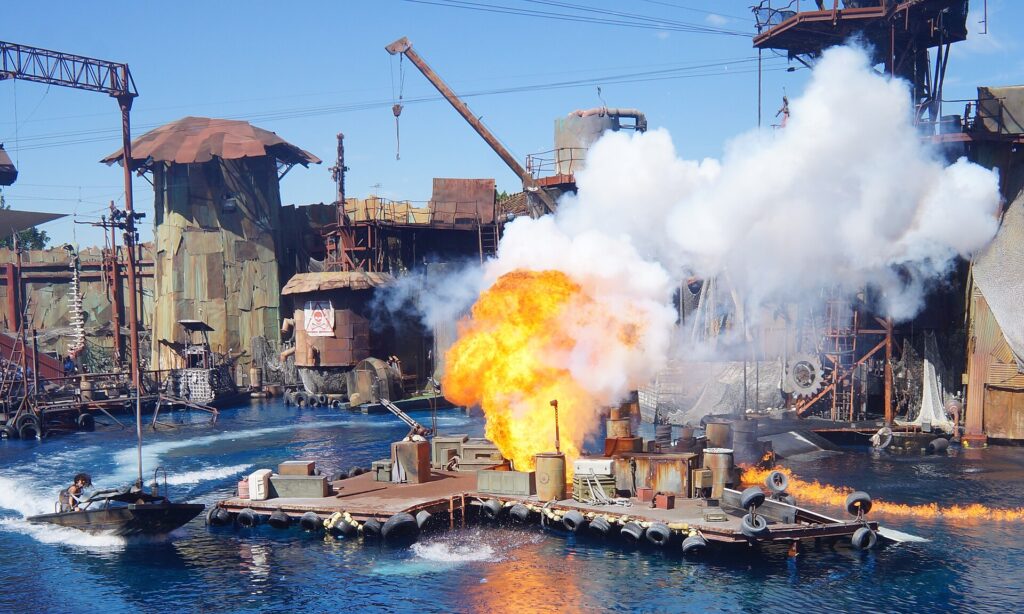
The Deez
The Deez is a city, a cathedral, a fuel depot, and a ship, in that order of importance. Its people live on the deck among gun mounts and rust-eaten cars, row in its belly, and go down into its tanks only to measure the god. Over the bridge, where another people would hang an icon, hangs the ship’s original commandment: NO SMOKING. The Smokers left it up. Of the forty readings I’ve tried, the simplest holds: it’s the one law of the old world they can see from anywhere on deck, and they break it in plain view all day long, which is what a people does with a law it wants to remember breaking.

The name is the strangest relic aboard. The old world’s records say the Exxon Valdez ran onto a reef in Alaska and then spent twenty-three years trying to become somebody else. She was the Exxon Mediterranean, the SeaRiver Mediterranean, the S/R Mediterranean, the Mediterranean, the Dong Fang Ocean, and finally the Oriental Nicety, and in 2012 she was run up a beach at Alang, in India, and cut apart. The reel shows her afloat, whole, and wearing her first name. Either the records lie, or the Smokers found another hull and gave it the name the old world had worked so hard to scrub off. I believe the second. Saints’ bones travel. So do saints’ ships.
Old Saint Joe
Every congregation needs a saint, and the Smokers chose theirs with a logic that took me a season to admire. His portrait hangs aboard the Deez. The Deacon toasts it from a whiskey bottle, speaks of “Old Saint Joe” the way a deacon should, and, when he learns how little oil the tanks still hold, cries “Sweet Joe!” the way a drowning man calls on whoever he hopes is listening.
The face is Joseph Hazelwood’s, master of the Exxon Valdez. On the night of March 23, 1989, his ship left the port of Valdez carrying some 53 million gallons of crude. Just after midnight she struck Bligh Reef, tore open eight of her eleven cargo tanks, and gave about 11 million gallons to Prince William Sound. NOAA’s incident summary records oil reaching more than 1,100 miles of coastline, and the old world’s estimates of the dead ran to a quarter of a million seabirds, thousands of sea otters, hundreds of seals and bald eagles, and 22 orcas. Hazelwood wasn’t at the wheel; a third mate was. He was acquitted of every felony and convicted of a single misdemeanour, the negligent discharge of oil.
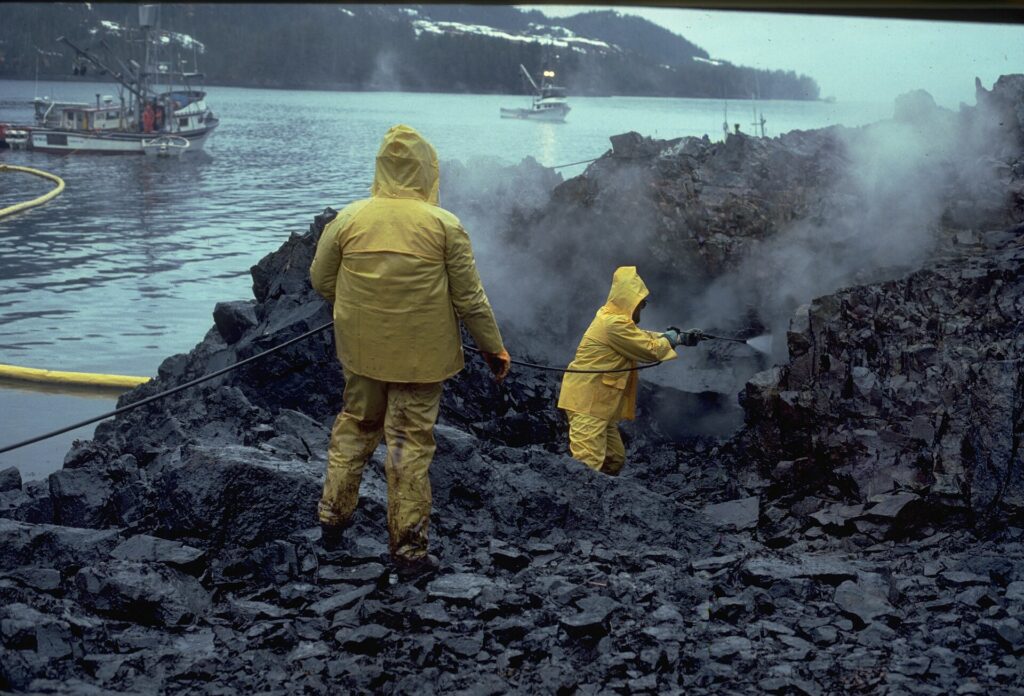
The old world answered with a law, the Oil Pollution Act of 1990, which barred the ship from the Sound for good and began the long end of the single-hulled tanker. To the old world, Hazelwood’s night was a scandal. To the Smokers, it’s a hagiography. Here was a man who carried more go-juice than a village could burn in a thousand years and gave it to the sea in a single night. The old world saw waste. The Smokers see an offering on a scale they can only dream of. Most saints are remembered for what they gave up. Saint Joe gave everything up at once, and the Smokers, who measure holiness in gallons, have never heard of a holier man.
Go-juice
The Deacon’s sermons make oil sound like the thing that holds the congregation together. The Smokers call it go-juice. The old man who lives down in the tanks with a measuring gauge calls it “the black stuff,” in the hushed register other peoples keep for the names of gods. The faith’s proper name I learned from a private conversation that survives only in the long cut of the reel. The Deacon complains to Enola, the captive child, that he hasn’t room for all his people. She tells him how they managed on the atoll: a baby was born when there was room for one. He calls that a quaint suggestion. His people, he explains, are the Church of Eternal Growth, and what they need is more land for more people. She’d offered him a way to live on what he had. He wanted to know where to get more.

Everything follows from that name. Growth means burning, and burning means smoke. The jet skis, the seaplane, the gunboats, and the Deacon’s own car all burn the god to move, and all of them leave a black plume behind, which the Smokers wear the way other peoples wear incense. The cigarettes are the same sacrament in miniature: a private, portable burning, kept behind the ear and lit at every pause. A Smoker who isn’t burning something is, by the doctrine, in a state of lapse.
The old world had a scholar for this faith before it had the faith’s last congregation. Stephanie LeMenager, in Living Oil (2014), named the old world’s way of life petromodernity: a modern life built on cheap oil so thoroughly that its people could no longer picture themselves without it. The Smokers are petromodernity after the oil, still living by its liturgy with the tanks nearly dry. When the gauge-keeper reports how little is left, I expected an order to cut the fleet’s runs. What comes instead is a promise about Dryland. The Deacon’s paradise is a place to take things out of, not a place to grow things in, and nobody cheering on the deck seems to have asked how low the tank is.
The Deacon
In the old world’s churches, a deacon was the officer who served at the table and handed out the alms. The title fits better than the reel-makers may have meant. The Deacon’s authority rests on largesse. He drives the length of the deck in a rust-eaten car, flinging cigarettes and cans of Smeat into the crowd, and the crowd scrambles for them the way the old peoples scrambled for coins at a coronation. Smeat is the Smokers’ manna: a pink, salted, everlasting meat from the old world’s pantry, stored aboard in such quantity that the Deacon can afford to throw it.

He preaches daily; one address ends with “So ends your daily sermonette!” He also lies, and the lying is liturgical. When the oil runs low, he tells his people he’s read the map tattooed on the back of Enola, the captive child, and that Dryland is “not just our destination,” but “our destiny.” He hasn’t read it. Nobody aboard can. But the congregation goes below and takes up the oars, and the Deez moves under human muscle: a people who worship the engine, rowing its corpse toward a promise.
His body is a reliquary, too. When the raid on the atoll costs him an eye, his people paint a ball bearing to fill the socket. He asks how it looks. They tell him they like it. He tells them, with some precision, what it actually looks like, and trades it for a patch. A priest-king who refuses his congregation’s flattery is rare in the reels, and I’ve grown fond of him for it.
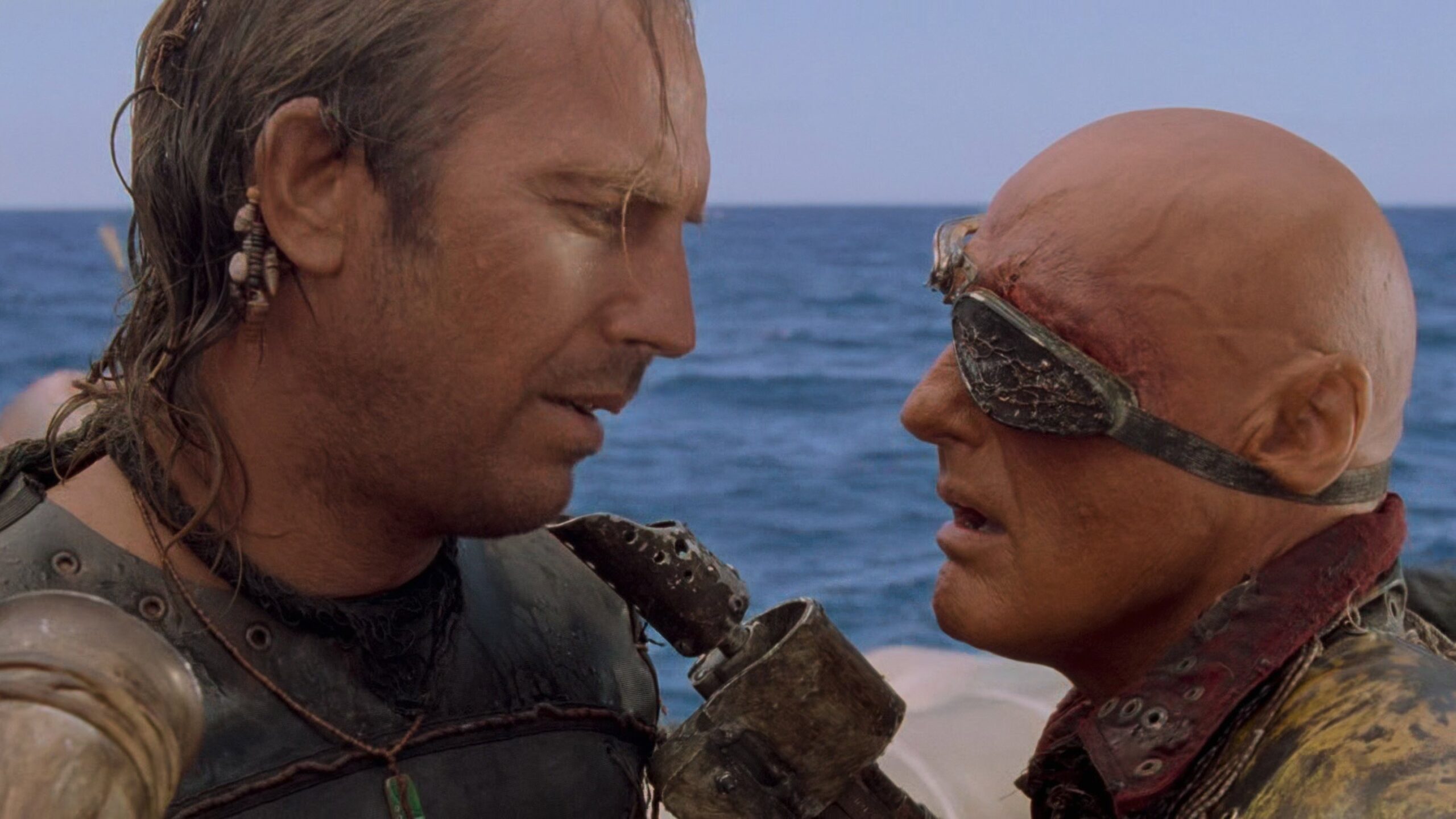
Two economies of the dead
To understand the Smokers, you need their neighbours. The Atollers live behind walls of salvage, drink “hydro,” and trade in dirt, which is worth more than anything else on the water. When one of them dies, they lower the body into the tank where they make their soil, and the dead go on to grow tomatoes. Both peoples live on the dead. The Atollers keep theirs close and recent, composted, still known by name. The Smokers worship the very old dead, creatures that sank into the earth before anyone was there to mourn them, pumped up from the dark and burned for speed. One people waits for its dead to become something; the other can’t wait. That, to my mind, is the whole quarrel between them, and most of the reel.

Look at the two wardrobes side by side and the quarrel shows. The Atollers knit, weave, and patch: caps of netting, layers bleached by salt, nothing that couldn’t be unpicked and made again. The Smokers wear what the old world wore to burn things: leather, goggles, and grease, darkened at every edge by their own exhaust.


The raid
The Smokers’ great rite is the raid. They come out of the haze on jet skis, throwing rooster tails of white water, and go over the atoll’s walls on ramps, which is the entrance a people makes once it’s decided the sea belongs to it. They burn what they can’t carry. They prop up the dead of a trading post to wave a stranger in. After a burst from the four-barrelled gun, they gather up the spent brass, because a church that burns everything else must save something.
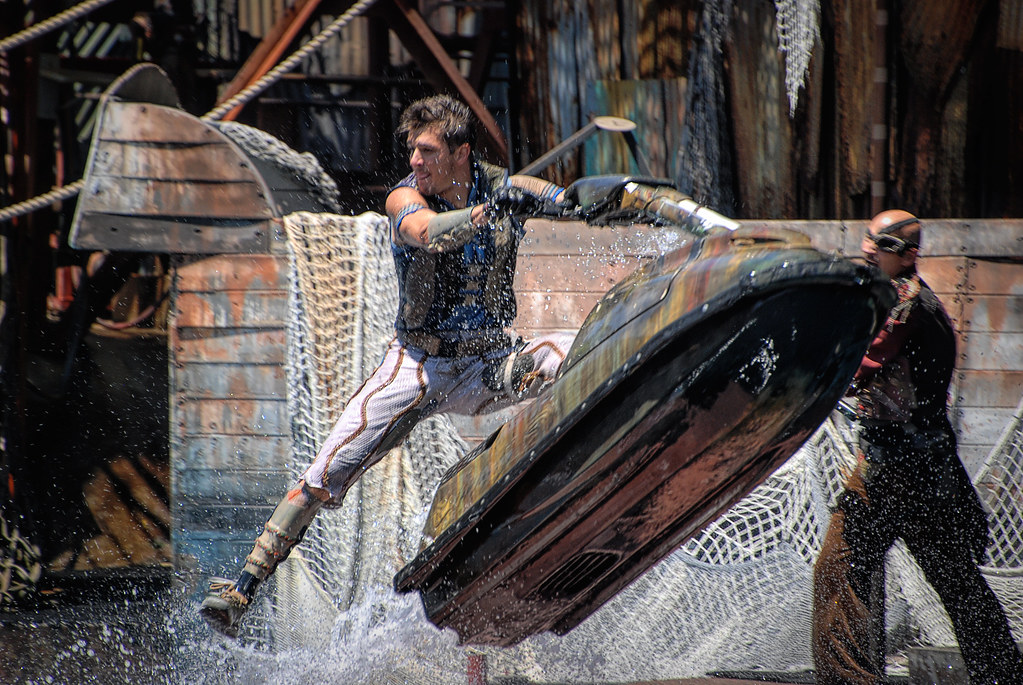

At the fires we keep a law: the stranger drinks first. On the Deez, the stranger is told to row.
Their deaths are ceremonial, too. At the end of the reel, the Deacon and two of his men race on jet skis from three directions toward one falling child, and meet in the middle as a single fireball. I don’t believe the reel-makers intended a theology. The Smokers would find one anyway: three engines, one flame, and the god taking back his own.
What the old world made of it
The reel’s first critics were unkind. Owen Gleiberman, in Entertainment Weekly, called it “a brazen knockoff” of an older desert reel. Heather Wintle, in Wandering into the Wasteland (2013), answered that in this world “roads are literally submerged,” and moved on to better questions. The best reading I’ve found of the Smokers themselves came later. L. D. Mattson and Jeremy Gordon, writing in Environmental Humanities (2022), noticed how carefully the Smokers keep out of the water. They skim it on jet skis, and when one falls in, he doesn’t come up. Their element is fire. The authors read the Deacon’s Dryland sermon, with its promise to dam every river and ram every tree, as an old creed of conquest that has outlived its world, a petro-masculinity “out of time.” They didn’t spare the Atollers either: a people can adapt perfectly well to the water and still condemn a man for having gills. I’d been keeping the Atollers as the Smokers’ better neighbours. Mattson and Gordon made me put a note in the margin. The Smokers, I suspect, never read their reviews. They were too busy rowing.
The shrines
The old world was so taken with the Smokers that it built them shrines. At pleasure-grounds in Hollywood, Osaka, Singapore, and Beijing, crowds sat on wet benches beside a lagoon of painted rust and watched the raid performed: the jet skis, the burning tower, the seaplane falling into the water, a man in flames dropping from a gantry. Several photographs on this page were taken there. In the reel, the Deacon dies once. At the shrines, he kept coming back. The old world had a church of eternal growth of its own, and it knew how to keep a congregation returning.





Participant observation
I’ve sat with peoples who let me watch and peoples who wouldn’t, and the Smokers belong to a third kind: they insist that you join. Come to the October shore as one. Come rust and black and tarred at the edges, hung with the old world’s plastic, goggles on your forehead, an unlit pack behind the ear and a tin of Smeat in your pocket for anyone who looks hungry.
Carry one thing another deckhand might ask to borrow: a battered tin with a label, a gauge that measures nothing, a rag that has seen better oil. Bring a crew; a lone Smoker is just a castaway with bad habits. Learn to cry “Sweet Joe!” and to point at the horizon with total confidence. And when your Deacon tells you he’s found Dryland, don’t ask to see the map. Pick up an oar.
We’ll keep the kettle on.
The Reel Peoples
Sixteen peoples from the old reels and two from our own shore, written up at the fires by Perpétue Kettlewell, with a costume guide for each.
- No. 1The War Boys of the Citadel
- No. 2The Smokers of the Deez
- No. 3The Citizens of the Capitol
- No. 4The Bartertowners
- No. 5The Vuvalini of Many Mothers
- No. 6The Waiting Ones
- No. 7The Holnists
- No. 8The Londoners of the Traction City
- No. 9The Galadhrim
- No. 10The People of Zion
- No. 11The Droogs
- No. 12The Ape Society
- No. 13The Judges of Mega-City One
- No. 14The Morlocks
- No. 15The Aviators of Airhaven
- No. 16The Tail Section