


Les gens du Capitole
Au défilé, le travail des districts devient un spectacle de mode. Les mêmes spectateurs qui applaudissent les costumes regardent ensuite les enfants entrer dans l’arène.
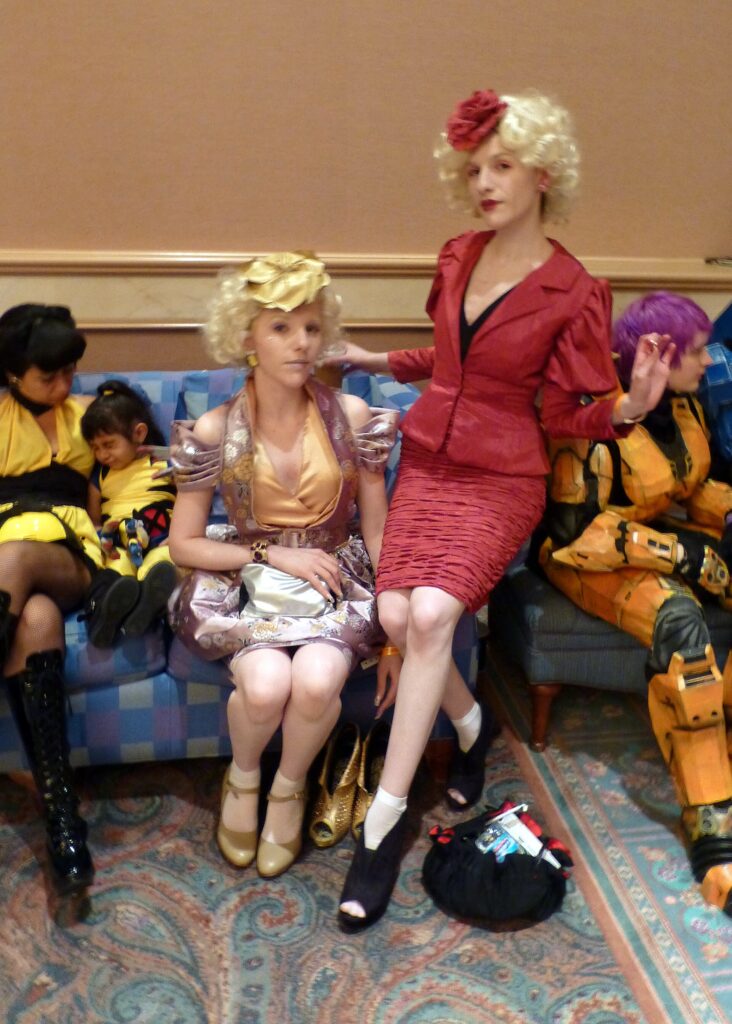
Idée de costume. Choisissez un métier du spectacle. Une escorte peut porter une veste sculptée et une fleur énorme. Pour une personne dans le public, les couleurs, la coiffure et un détail démesuré suffisent.
L’essai intégral et le guide détaillé sont en anglais. Lire l’essai · Voir les références visuelles

The Reel Peoples · No. 3 of 16
The Citizens of the Capitol
Notes on a People Who Watch
Perpétue Kettlewell, written at the fires, 2285
Photo: Ryan Quick, CC BY 2.0

Most peoples who sacrifice their children at least have the decency to believe in a god who wants it. The citizens of the Capitol have no such god. They have a broadcast schedule.
We know them from six reels, beginning with The Hunger Games (2012) and continuing through Sunrise on the Reaping (2026). They live in a gleaming city in the mountains of a country called Panem, fed by twelve districts that grow, mine, weave, and fish for them. Once a year each district gives up a boy and a girl, chosen by lottery, and the twenty-four are set loose in an arena to kill one another until one is left. The citizens watch, and a whole profession of stylists, escorts, and producers makes sure they keep watching.
The liturgical year
The Capitol keeps a calendar as dense as any monastery’s. First the Reaping, when an envoy in full regalia draws two names from two glass bowls in every district square. Then the Parade, when the chosen ride into the city in chariots, dressed by Capitol stylists to embody their district’s trade. Then the Interviews, the Games, the Coronation of the victor, and the Victory Tour, when the survivor is sent around the districts to stand before the families of the children they outlived. Every twenty-fifth year there’s a Quarter Quell, a jubilee with a twist in the rules, because even a liturgy needs a feast day.

The Parade deserves a closer look, because it’s where the Capitol’s aesthetic shows its hand. Each pair of tributes is dressed as their district’s labour: the mining district’s children in coal and flame, the fishing district’s in nets, and so on around the map. The work that feeds the city becomes ornament for one evening and is paraded past the people it feeds. The crowd adores it. It’s the only time most citizens will ever look at a district’s trade, and they see it as fashion. That’s a court, summed up in one evening.
The woman who first set the tale down has said where she found the pattern: in the old Greek story of Athens sending seven boys and seven girls each tribute year to Crete, to be fed to the Minotaur in the labyrinth. The Capitol even kept the word. The chosen children are “tributes.” In the old story, Crete was the monster’s city. In this one, the monster is the audience, and the audience lives in Crete.
The invention of a rite
Most rituals hide their origins. This one was filmed being invented. The Ballad of Songbirds & Snakes (2023) takes us back to the tenth Games, a few years after a war that left the Capitol itself hungry: the young Coriolanus Snow and his cousin keep up appearances in a faded penthouse, and the Games are a shabby affair in a bombed-out arena that few citizens bother to watch. Then the city’s young are made mentors, gifts begin to reach the arena, wagers are laid, a host with a weather segment takes the microphone, and a tribute gets to sing. Within a single season, a punishment becomes a programme. It’s the best field record I know of a people learning to love what it does.

The surface
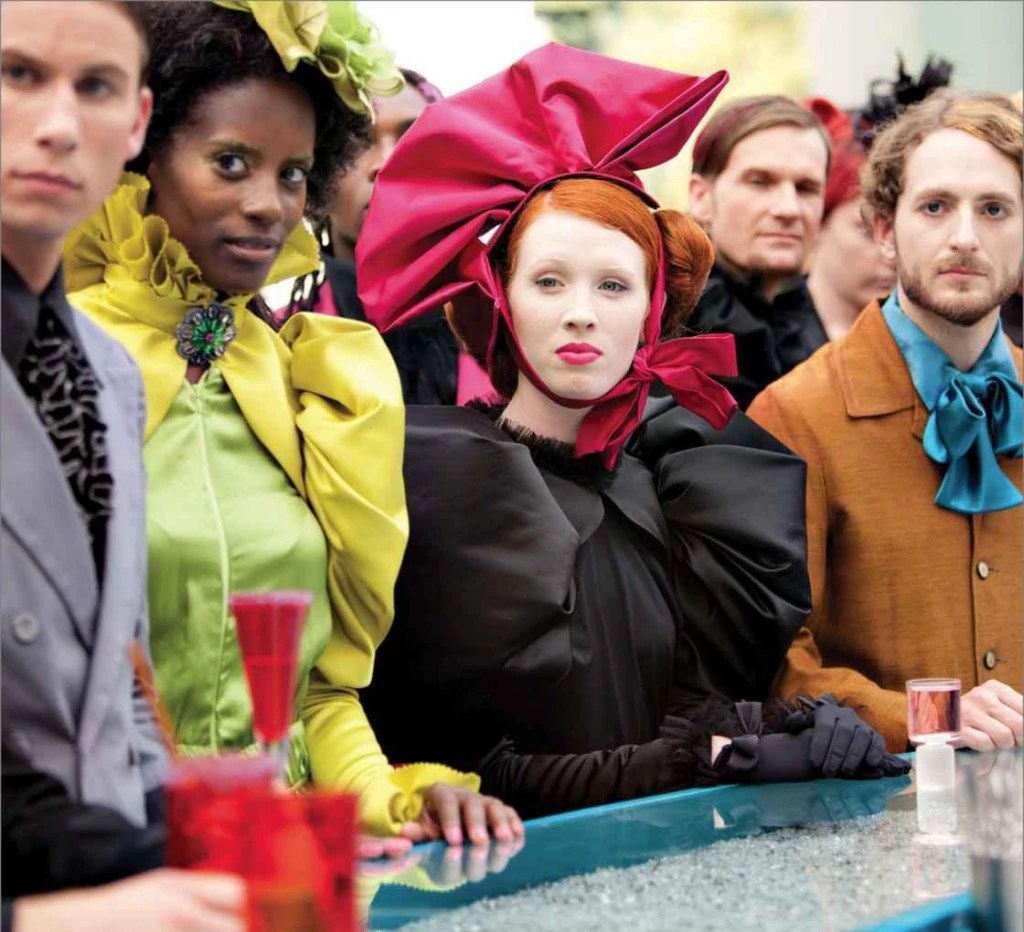
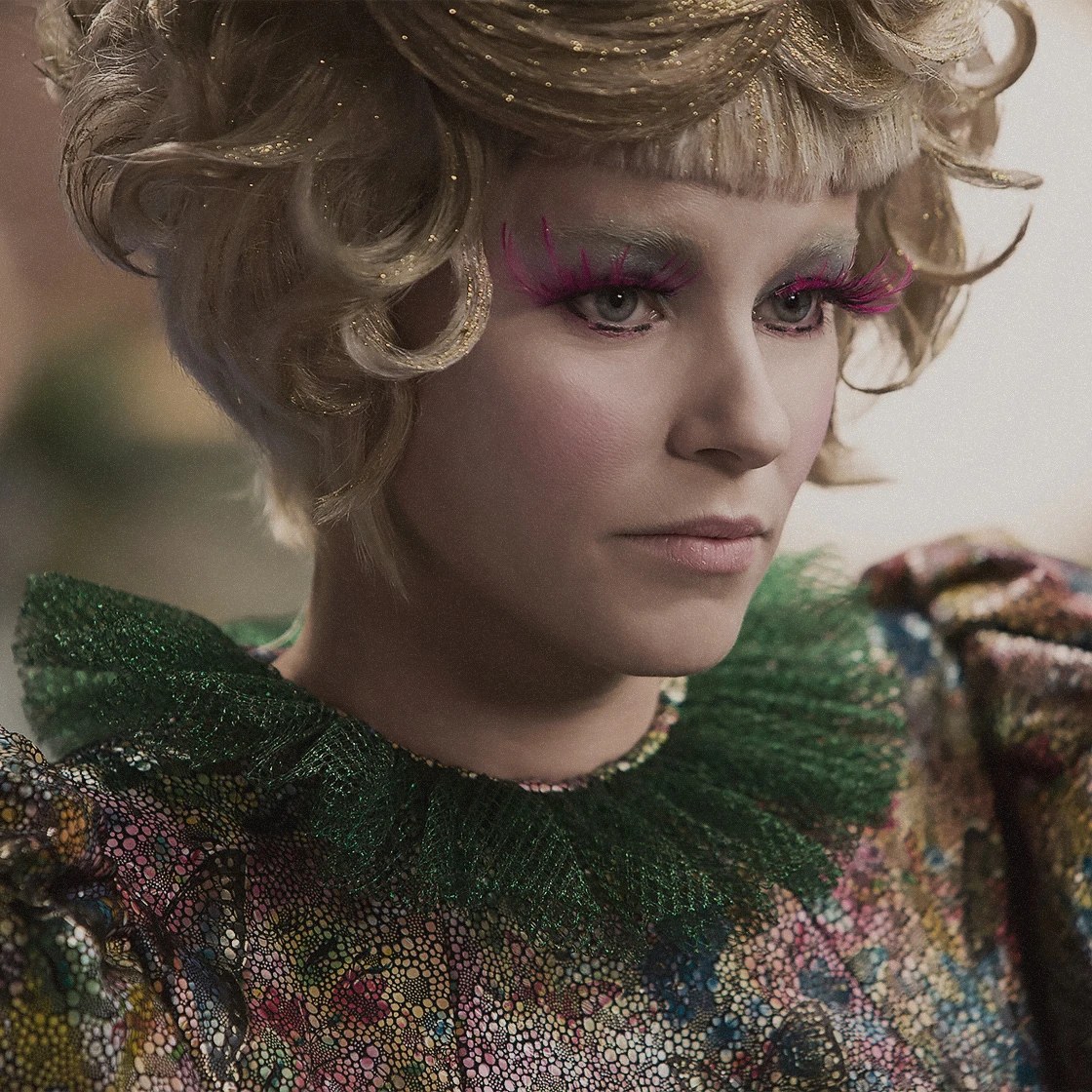
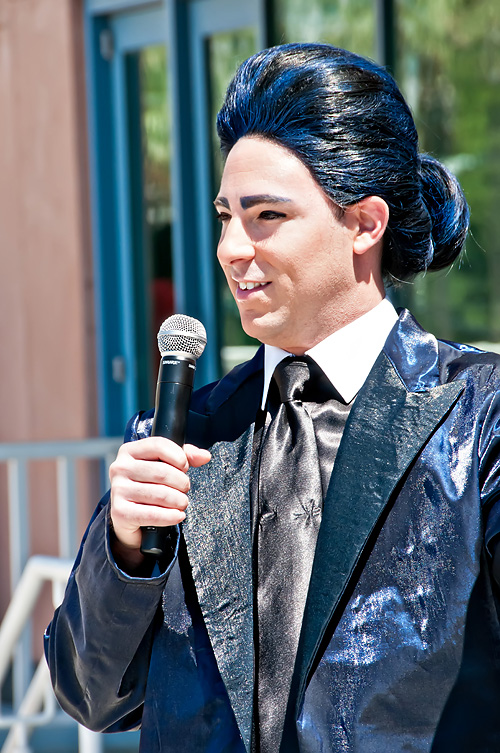
The citizen’s body is a canvas, and the canvas is never finished. Hair is a wig, and the wig is a colour that doesn’t occur in nature: cotton-candy pink, chartreuse, a navy blue tied back in a little ponytail. Eyebrows vanish. On the first reel, some five hundred performers had theirs bleached to get the look. Lashes become feathers, butterflies, or paper. Skin is powdered, dyed, jewelled, or gilded. The furthest of them, a woman named Tigris, has had her face surgically drawn into a cat’s, whiskers included, which the Capitol regards as dedication rather than distress.

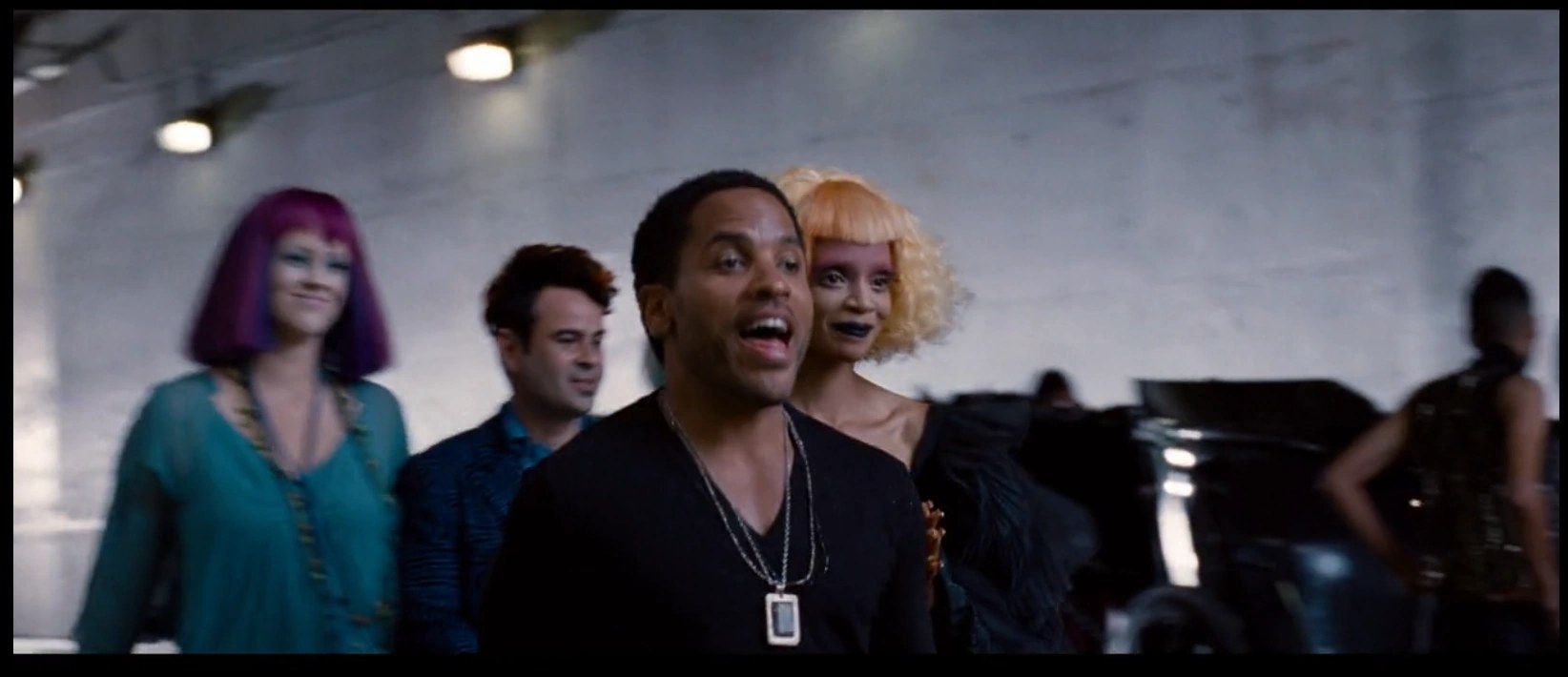
The two ends of one such life are on record. In the Ballad reel, Tigris is a young apprentice in a fashion house, in a pink suit with strong shoulders, quick and kind. In the last Mockingjay reel, sixty-odd years on, she keeps a dim shop of fur-lined clothes behind a face surgically drawn into a cat’s, and she hides the rebels in her cellar. The face the Capitol made famous turns out to be the one place its cameras never thought to look.

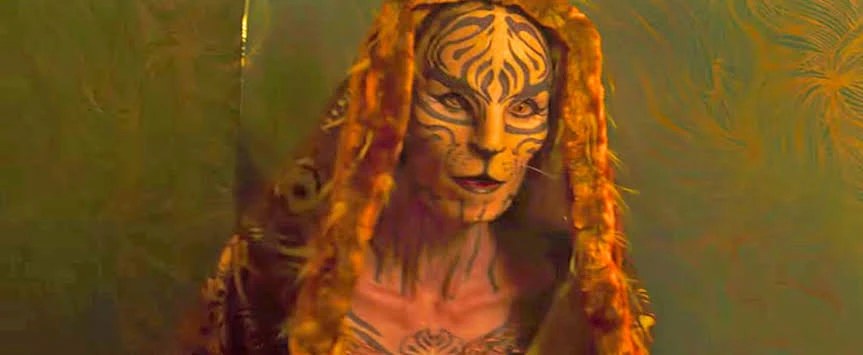
I’ve seen this pattern before, in the old world’s own records. The last French court at Versailles dressed its hair a yard high, powdered its faces white, and starved the countryside that paid for the powder. The reel-makers clearly saw it too. The first reel’s costumer looked to Elsa Schiaparelli and Alexander McQueen; the effect is Versailles with cameras. What interests me is the logic underneath. In the districts, the body is a tool, and tools are kept plain. In the Capitol, a body that does no work has to say something else, so it says everything at once.


The old world’s scholars noticed the same thing. The philosopher Christina Van Dyke read the Capitol through Michel Foucault’s idea of the “docile body” (2012): the citizens’ endless attention to their own surfaces is the very thing that keeps them in line, because a people busy with its eyebrows has no time left for its government. The leash is the mirror. I’d add one observation from the field. Nobody here experiences the leash as a leash. Ask a citizen and she’ll tell you she’s never felt freer.
The wardrobe department
A people this devoted to surfaces leaves an unusually rich material record, and the reels left one of their own. The reels passed through several costume designers’ hands: Judianna Makovsky for the first, Trish Summerville for the second and again for the Ballad, and the pair known as Kurt and Bart for the two Mockingjay reels. In the autumn of 2013, more than two hundred costumes from the first reel were sold at auction, and the catalogue survives. I’ve spent more evenings with it than I should admit. Laid out on dress forms, without their wearers, the clothes look exactly like what they are: the vestments of a church that worships being looked at.
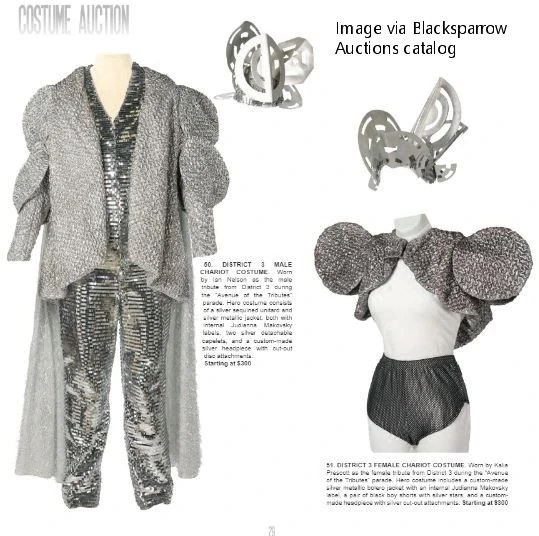
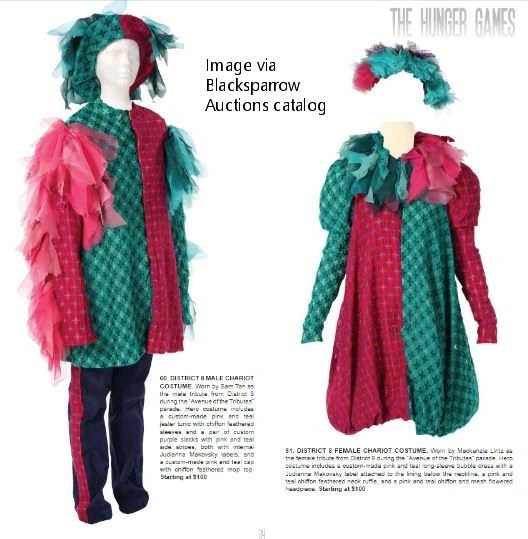
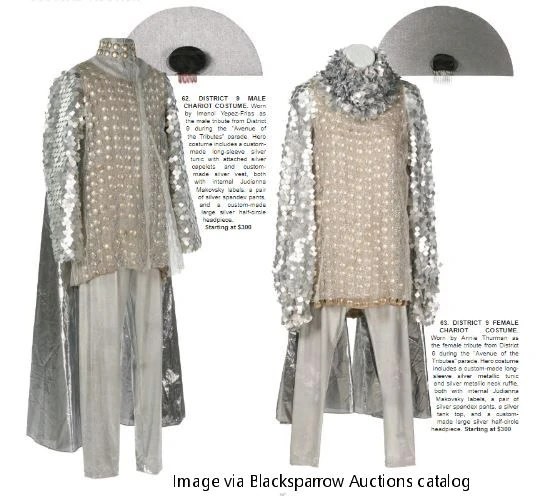
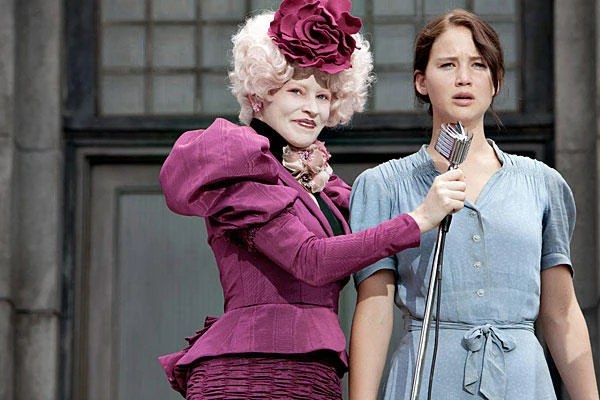
Notice the silhouettes as much as the colours. The cut is often old: nipped waists, padded shoulders, the evening wear of a century before the reels were made, inflated until it can be seen from the back of an arena. Effie’s wardrobe is the clearest lesson. Each suit is tailored hard, then interrupted with something impossible: a ruff of feathers, a headdress of silk flowers, a wig in a colour that has never grown on anyone.
The table
The Capitol’s great sacrament happens at its parties, and it’s the one that shocks visitors most. The tables hold far more than any guest could eat. When a guest is full, the guest drinks from a small glass that makes them vomit, and then goes back to the table. On the second reel, two of the stylists offer the drink to a pair of tributes from the poorest district with the delight of hosts sharing a secret recipe. The tributes, who’ve buried neighbours dead of hunger, put the glasses down.
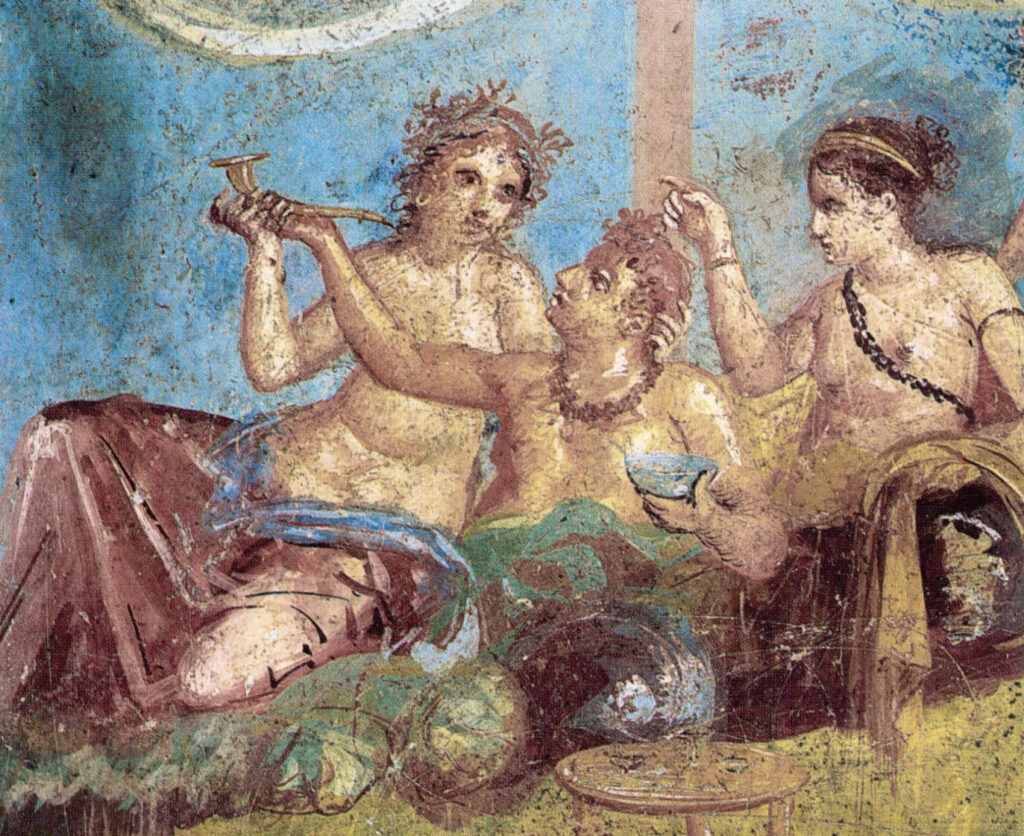

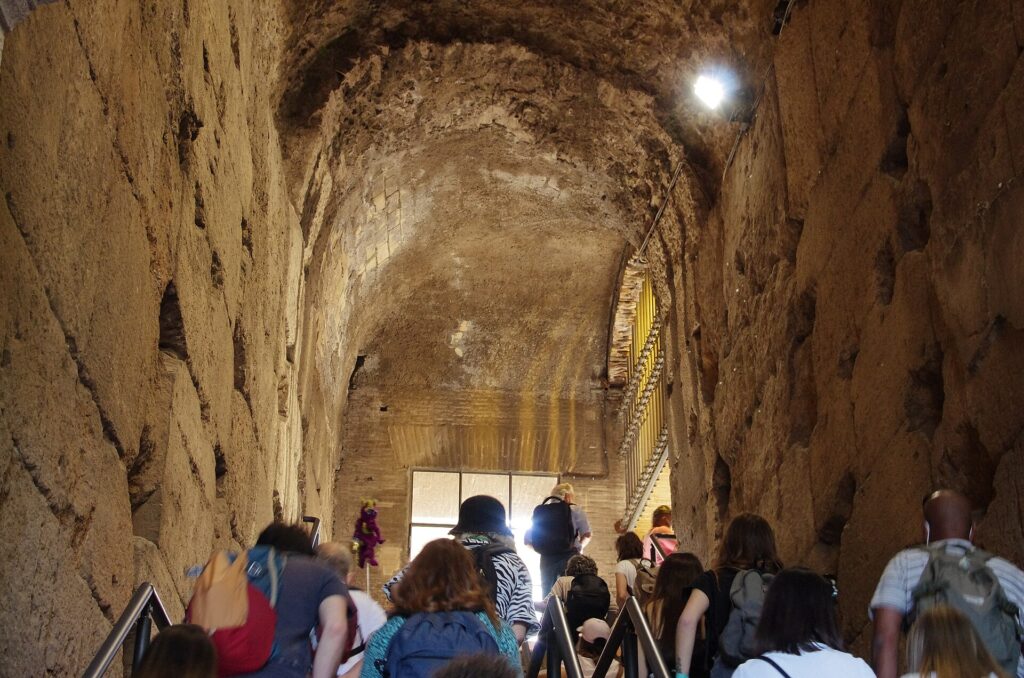
The old world told a story about the Romans: that they kept a room called the vomitorium for exactly this purpose. It was never true. A vomitorium was a passage in an amphitheatre, named for the way it “spewed” the crowd out onto the streets after the games. So the Romans built the word for their arenas, and the Capitol built the room for its banquets. A people who named their country after a Latin slogan ended up making a Latin mistake come true.

The names
The slogan is panem et circenses, “bread and circuses,” from the Roman satirist Juvenal, who meant it as an insult: a people who’ll trade their freedom for free grain and a good show. The Capitol took the first word as its country’s name and the second as its national calendar. Its citizens carry Roman names, too: Caesar, Seneca, Plutarch, Cinna, Octavia, Flavius, Coriolanus. In the districts, children are named for plants and the weather. In the Capitol, children are named for the old empire. Each people names its children after what it hopes they’ll inherit.
The manners
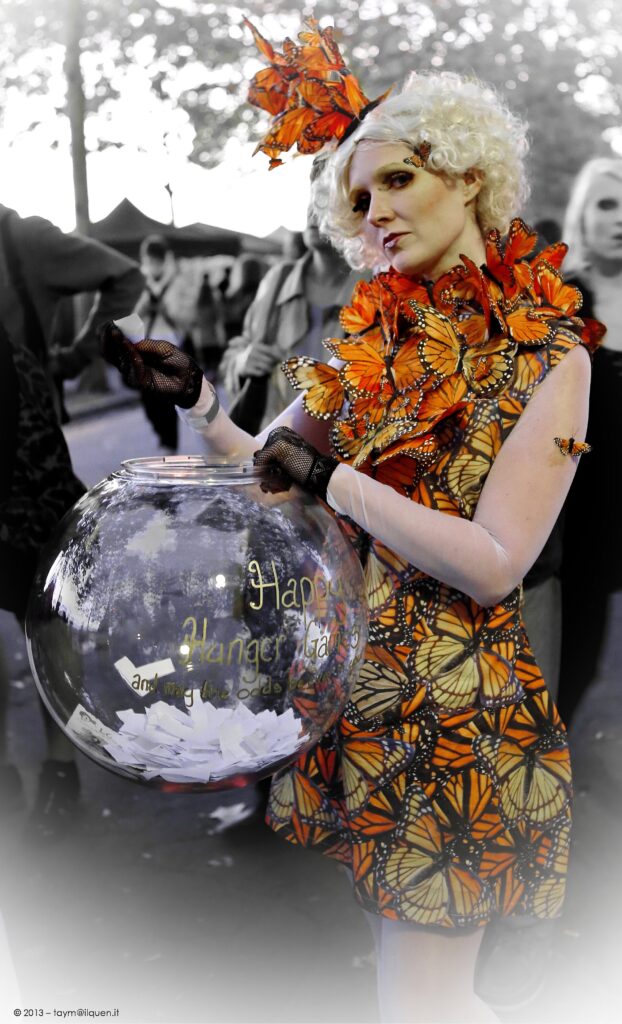
The Capitol’s priesthood is its escorts, its stylists, and its host, and none of them would recognise the word. The district escort is Effie Trinket, and she’s the best-observed Capitol citizen in all six reels. She keeps the schedule. She polices the cutlery. When a drunken mentor drives a knife into a dining table, her horror isn’t for the violence: “That is mahogany!” She ends every Reaping with the benediction the whole country knows: “Happy Hunger Games! And may the odds be ever in your favor.”

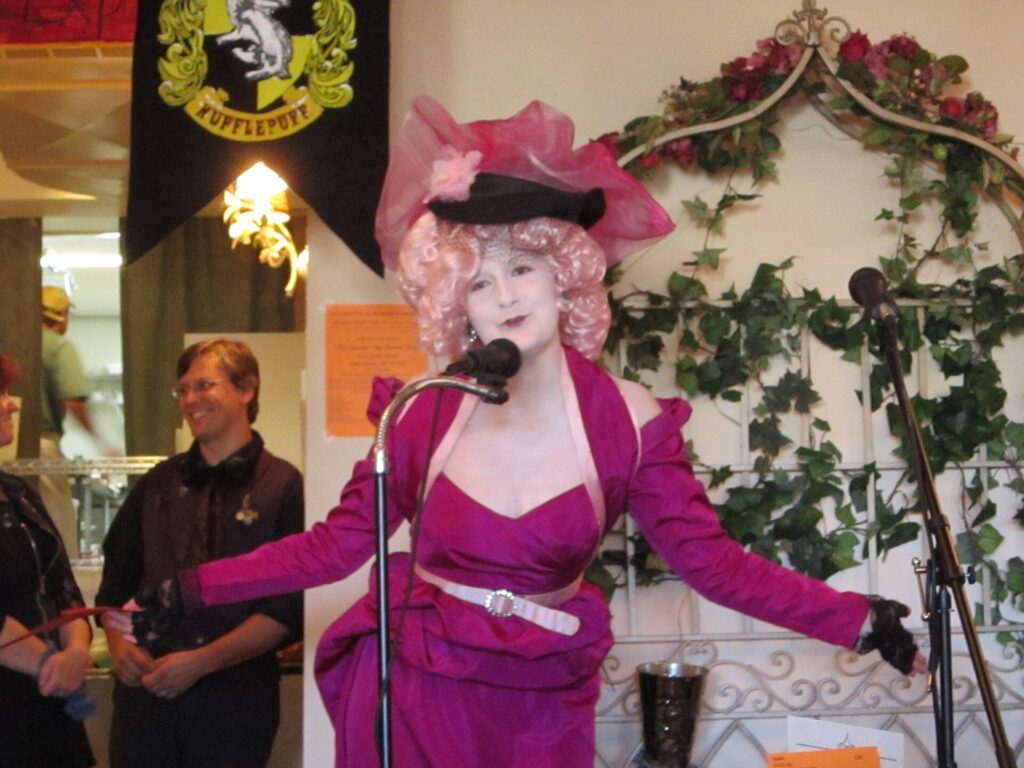

Read that benediction slowly. The Capitol’s god, it turns out, is probability. The lottery is its sacrament of selection, and the odds are the closest thing it has to providence: impersonal, numerical, and safely aimed at somebody else. A citizen’s own name is never in the bowl. That’s what it means to be a citizen.
At the fires we keep a law: the stranger drinks first. In the Capitol, the stranger is watched first.
The president keeps a symbol of his own. Coriolanus Snow wears a white rose and leaves white roses where he wants to be felt, bred, the old tale says, for a scent strong enough to hide the blood on his breath. Every court needs an emblem its subjects can buy, and every citizen of rank, I’d wager, keeps a rose somewhere. They take it for elegance. The districts take it for a warning, and the districts are right.
The tears
Here’s what I didn’t expect. The citizens love the tributes. They weep at the interviews. They throw flowers at the chariots. They pool their money to buy gifts that drift down into the arena on little silver parachutes, a medicine or a loaf, and the mentors work the parties to raise it, the way the old world’s priests worked their donors. When two beloved victors are sent back into the arena on the second reel, the audience in the studio cries out against it. Their host, Caesar Flickerman, a man with a navy wig and a dazzling grin, is their high priest of feeling: he draws the tears out of the children and then out of the crowd, and everybody goes home moved.

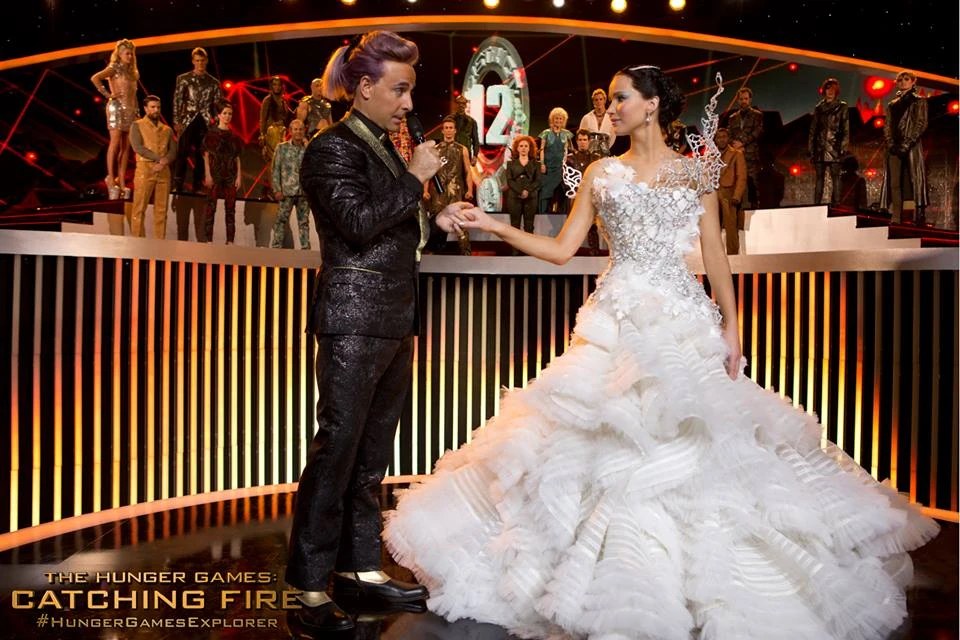
Before she goes on with Caesar, Katniss is coached in how to be liked. When he asks about the dress, she twirls, and the crowd sees her pleasure and the dress catching fire. Minutes later Peeta tells Caesar he loves her, and she learns only afterwards what the confession has done for her odds. Rachel Dubrofsky and Emily Ryalls, writing in Critical Studies in Media Communication (2014), argue that the reel, like its audience, rewards her for seeming not to perform at all, and they say plainly what the reward is made of. It’s whiteness, of two kinds. Hers is poor, plain, and lit to look natural: on the train to the city, light comes through the window and catches her face, and nobody has done a thing to it. The citizens’ whiteness is painted on, a ghostly foundation over the skin, and they’re proud of the work. I’d taken the Capitol’s two tastes for a contradiction, a people devoted to artifice cheering for a girl without any. It’s a single taste. The citizens know exactly what effort looks like, because they spend their days on it, and that’s what lets them recognise its absence and pay for it. I keep coming back to how many people have to look for that to work.
Notice, too, what they do with their hands. The districts have a gesture, three fingers raised from the lips, that means thanks, farewell, and, eventually, defiance. The Capitol’s only gesture is applause.

The old world had a phrase for this, from Guy Debord (1967): the spectacle, he wrote, is “a social relationship between people that is mediated by images.” The Capitol doesn’t lack compassion. It has a surplus of compassion and nowhere sensible to put it. The tears are real; they’re just aimed at a screen. And the reels are careful to show that a citizen can learn. In the Mockingjay reels, Effie is carried off to the rebels’ bunker, where she wraps a drab scarf into a turban, keeps her manners under the bombs, and finds out what the schedule was for. Even exiled, a Capitol woman finds something to drape.
The old world enlists
Of all the peoples in this series, the Capitol is the only one the old world was formally invited to join, and the old world accepted. When the first reel opened, its makers built a portal for “citizens” at TheCapitol.pn, issued visitors District Identification Passes, and published a fashion magazine called Capitol Couture. Two scholars of the campaign, Bridget Blodgett and Anastasia Salter, summed up its effect in five words: “readers are Effie, not Katniss.” For the second reel, cosmetics houses sold make-up lines in the Capitol’s colours. Joe Tompkins (2018) described a franchise that asked its audience to “simultaneously buy into and deconstruct” the spectacle it showed them. And when Rebecca Hill (2018) interviewed the old world’s readers, she found people of every politics casting the Capitol as somebody else: corporate elites, for some; big government and coastal decadence, for others. A few, to their credit, pointed at their own country. Most found the bowl-holders across the aisle, which is a Capitol habit too.
Participant observation
Every people in this series asks you to become them for a night. The old world already said yes to the Capitol once, mostly without noticing. I’d like you to say yes knowingly, because a costume is the only honest way to wear their eyes: you’ll know exactly whose eyes they are. Come to the October shore overdressed, in a colour no plant ever made, with your eyebrows gone and your lashes in flight.
Better still, come as two: the one who is paid to smile and the one who has to smile to stay alive. Let the difference show before either of you says a word. Carry a glass bowl of folded names and read one aloud with tremendous enthusiasm. Weep beautifully at a stranger’s story. And at some point in the night, when you’re enjoying yourself most, look around at whoever’s carrying your drinks, and wonder who’s in the bowl.
We’ll keep the kettle on.
The Reel Peoples
Sixteen peoples from the old reels and two from our own shore, written up at the fires by Perpétue Kettlewell, with a costume guide for each.
- No. 1The War Boys of the Citadel
- No. 2The Smokers of the Deez
- No. 3The Citizens of the Capitol
- No. 4The Bartertowners
- No. 5The Vuvalini of Many Mothers
- No. 6The Waiting Ones
- No. 7The Holnists
- No. 8The Londoners of the Traction City
- No. 9The Galadhrim
- No. 10The People of Zion
- No. 11The Droogs
- No. 12The Ape Society
- No. 13The Judges of Mega-City One
- No. 14The Morlocks
- No. 15The Aviators of Airhaven
- No. 16The Tail Section