Where the Words Went
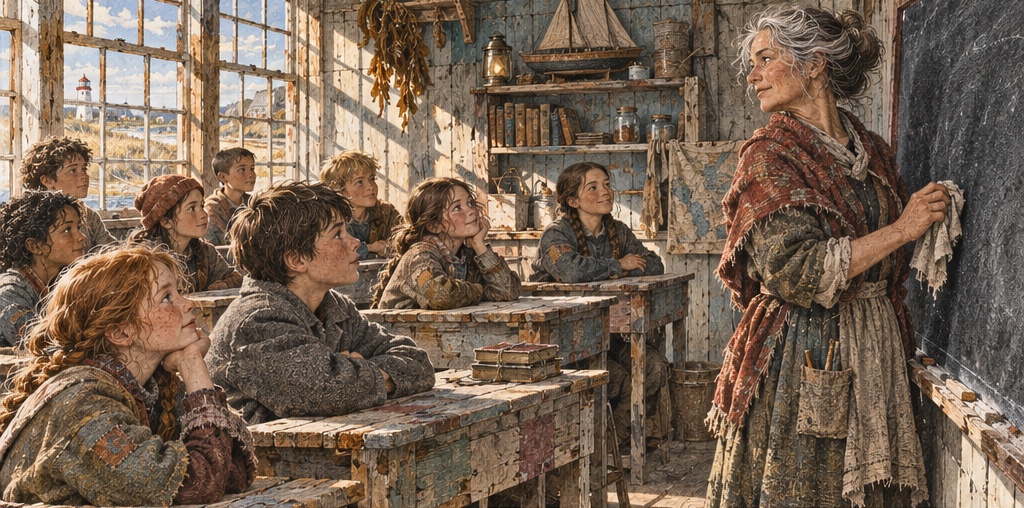
From Perpétue Kettlewell’s schoolroom at the ruin, Shediac, 2285
Every autumn before the First Fire, I teach the small ones the Five Ages, so they’ll know what the tellers are embellishing. This year I had nine. Eight were ours. The ninth was Grey, who’d walked over from the lee of the Red Room in a grey coat with COAT painted across the back. Tibo poured him tea before I could, which is really the whole lesson. We did the rest anyway, over three mornings.
The first was about words.
I wrote on the board one word, one thing.
“In the Beginning, tree meant tree. Water meant water. You pointed, you named, and that was all a word could do.”
“That sounds easy,” said Noisette.
“It was. Then the whole world agreed to talk that way together, which was easier still, and very boring. So they built a tower to have something to do. That was Babel. It fell.”
“Good,” said Tibo.
“The tellers agree with you. When the tower fell, everyone’s words ran off in different directions. Suddenly there were a thousand tongues. That’s the first age, the Scattering. People couldn’t agree on what to call a fish, and the world got rich.”
Hap had a difficulty with this. “How do you buy a fish if you don’t know what to call it?”
“Go on, then. Buy one. Mireille, you’ve got a stall. Hap, you’ve come a long way and you don’t speak her tongue.”
Hap pointed at an imaginary fish on Mireille’s desk.
“Hareng,” said Mireille.
“I’ll have two of those,” said Hap.
I sent him home to the far end of the bench. “Your brother wants to know what you bought.”
“Two hareng,” said Hap.
“There. Mireille stayed at her stall. Her word went home with Hap. Give people a few hundred years of trading and marrying and borrowing things off the neighbours, and you can hear where they’ve been every time they open their mouths. That’s the second age, the Braiding.”
I wrote espérer on the board.
“Now, suppose your mémère says « J’t’espère ». What’s she doing?”
“Waiting for me,” said Tibo.
“Hoping you’ll come,” said Mireille.
“Which one?”
They knew better than to settle that on behalf of anybody’s mémère.
“She can do both. That’s what people discovered about words one night in 1816, at a ball here in the Warm Place. With their masks on, they could say one thing and mean two, and the person listening could hear both. That’s the third age, the Masking.”
“So the mask hides the second meaning?” asked Mireille.
“Which bit did your mémère hide?”
Mireille thought about it. “I’d know she wanted me there.”
“And she’d still be waiting. A mask adds a floor. You can live on both. At eleven the masks came off, and everybody went back to saying one thing at a time. But this shore kept a few words from the ball. You’ve just heard one.”
“C’est weird, ça,” said Tibo.
“Two tongues in three words,” I said. “The tellers say Chiac came home from the ball that night. Around here, eleven struck and people went right on talking.”
The fourth age was the hardest to get onto the board. I asked them to picture a table long enough for everyone. At the Long Tea, a word could mean nine things by Tuesday.
“Hap, you’ve had your fish. Tell Mireille when you’ll pay.”
“Shortly,” said Hap.
Mireille held out her hand. Hap had already gone home to the far end of the bench.
“What?” he said. “I’m coming back Thursday.”
I asked Mireille what she’d heard.
“Before supper. The fish were for today.”
“When your mémère said she’d espère you, you heard everything she meant. These two heard ‘shortly’ and each went home with a different payday. How long before somebody notices?”
“Supper,” said Mireille.
There was a time you could turn to a neighbour and ask, “How would you say it in your tongue?” You’d soon find out whether you’d agreed to supper or Thursday. But one tongue seemed able to say everything. People used it more and more. Nobody sent the other tongues away. After a while they stopped coming to the table.
“What did they wear at the Long Tea?” asked Noisette.
“Whatever they had on. That’s the trouble with dressing up as the Long Tea. You’d just be dressed.”
“Was it a bad age?” asked Hap.
“It was a long one.”
“And then?”
“Then the words went flat. We call it the Unspelling. Think of your mémère again. Suppose she could tell you she’d waited. Suppose the word still told you exactly how long she’d sat there, and you could hear nothing in it about how much she’d wanted you to come.”
“No war, no sickness, no machine. A word going flat is quiet. Tree meant tree again, the way it had in the Beginning. Some people went so flat they emptied. Those are the Hollow. If one comes near, give it a round word, one that can still mean twice. Espérer works best. They wake for about four seconds.”
“Then what?” asked Mireille.
“Then you’ve given somebody four seconds. That’s not nothing.”
Tibo’s lips moved. He was counting to four. By the time he’d finished, I’d put the chalk down.
“Which brings us to the fifth age, Afterland. That’s us. We keep more than one tongue on purpose. We’re building a tower again, out of tongues this time, one telling at a time round the fires. It’ll never be finished, and it’ll never be one tongue.”
Hap had been counting the lines on the board.
“That’s eight.”
“Come and number the ages, then.”
He left the Beginning alone. He left Babel alone. Beside the next four lines he put his numbers. At the Unspelling he stopped.
“That’s when the Long Tea ended,” said Mireille.
Hap left it alone. Then he put a 5 beside Afterland. Here’s his board, which I kept for the younger ones.
| Before the ages · The Beginning | One word, one thing. |
|---|---|
| Before the ages · Babel | One world, one word, one thing. |
| 1 · The Scattering | A thousand tongues. |
| 2 · The Braiding | Many tongues, one word carried across. |
| 3 · The Masking | One word, two meanings. |
| 4 · The Long Tea | Every word, every meaning. |
| The end of the Long Tea · The Unspelling | One tongue, flat words. |
| 5 · Afterland | Many tongues, on purpose. |
At the door, Grey stopped.
“I will espère the fire.”
“Wait for it, or hope for it?” asked Tibo.
“Yes,” said Grey.
I’ve written that down as the morning’s last word. The fires can argue about which of us taught it.