

Everyone Came From Somewhere
From Perpétue Kettlewell’s schoolroom at the ruin, Shediac, 2285
On the second morning I asked who’d walked to school. Nine hands went up.
“Good. Today is about walking.”
I drew the tower on the board. It leaned a little, which saved time explaining what happened to it.
“When Babel fell, people walked away in every direction and took their words with them. That’s the first age, the Scattering, and it’s why we’re called the Scattered. Think of scattering seeds. Wherever those people stopped, something grew. The tellers say the Scattering was a sowing.”
“Did they get lost?” asked Noisette.
“Some did. Most just got somewhere else. Some came to this shore and found its own people already here, speaking Mi’kmaw.”
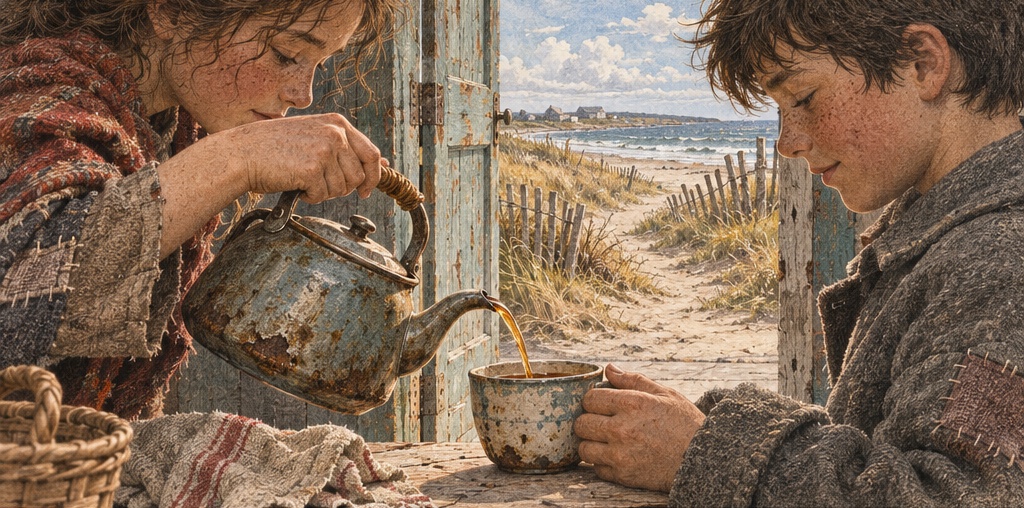
“And when you’ve walked a long way, sooner or later you come to a stranger’s door. There’s an old rule about that. The stranger drinks first. You hand over the cup. When they’ve had their drink, somebody asks, ‘Who are you?’”
“What if they won’t say?” asked Hap.
“Then they’ve had a cup of tea and you’ve had a visitor.”
This satisfied him. “What if I go to Mireille’s stall again?”
“Then we’re in the second age. In the Braiding people walked to trade. Mireille has fish. Somebody up the road has cloth. Each has a good reason to walk to the other, and by the time they’ve done it a dozen times, they’ve carried quite a few words along with the fish. The question you hear at the door in the Braiding is ‘What do you carry?’”
“Fish,” said Hap, who’d apparently gone into business.
“Fish will do. There were four other things people carried that you couldn’t put in a basket. I’ll bring those tomorrow.”
“By the third age, the Masking, the roads were better. Two people who lived a long way apart could reach the same ball on the same night. At the door somebody asked, ‘Who are you?’ Only now you had your own face and the mask you’d chosen. Every guest had two answers.”
“Even the person at the door?” asked Mireille.
“Especially the person at the door. They’d been there all evening to think of a good one.”
“In the fourth age, the Long Tea, people could go almost anywhere. Every tongue in the world could sit at one table.”
I gave Tibo the pot and asked the others to tell one another what they’d had for breakfast. They took to this part of the lesson very well.
When they’d finished I asked, “Who heard Tibo pour?”
Grey put up his hand. Tibo had filled his cup.
“That was the Long Tea. You could sit down, talk all evening, and go home again without anybody ever asking who you were. After a while the other tongues stopped coming. Then the words went flat.”
“Is that when the Hollow started walking?” asked Noisette.
“Yes. The Hollow walk towards the sound of somebody speaking plainly. You’ll sometimes see them near the Red Room. A round word can wake one long enough to look at you.”
“After the Unspelling, the Scattered walked again. From camp after camp they followed the warm water to a town the flattening never quite finished. That’s here, the Warm Place. We light our fires in the ruin. And if somebody comes in from the cold, we still know what to do with a cup.”
“What about the people at the Red Room?” asked Mireille.
“The Flat-Tongues live there, in the lee of the ruin. They kept the flat word, and they aren’t Hollow. With them, a word means exactly what it says.”
“Grey’s a Flat-Tongue,” said Noisette.
“Yes,” said Grey. “My coat says COAT.”
“Do you give a stranger tea at your house?” Mireille asked him.
“Yes.”
“Even if you don’t know their name?”
“How would I know their name? They have just come in.”
Tibo, who still had the pot, looked rather pleased.
“Grey walked here from the Red Room,” I said. “Pyrus, the Pear Tree Man, walks the other way. He goes there to teach round words.”
Grey finished his tea and set the cup down.
“Who are you?” I asked.
“I am Grey.”
“Where did you walk from?”
“There.”
“And where are you now?”
“Here.”
I’ve taught the Scattering for eleven years. He did it in two words.